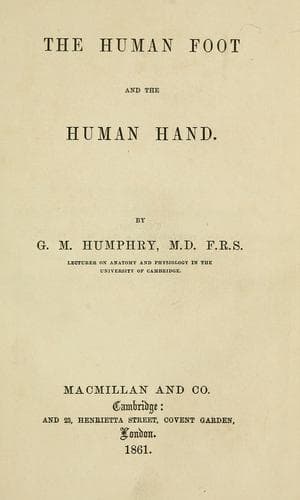
The human foot and the human handHumphry, George Murray, Sir
Science
The human foot and the human hand
Humphry, George Murray, Sir
Foot; Hand
In the ELEPHANT the mouth is circumstanced, somewhat, as in man; and
the office of feeder is performed by the elongated snout or proboscis.
This organ, with its finger-like extremity, is so sensitive and mobile
as to be able to pick up small bodies--pins or needles--from the
ground, and so strong as to pull down large branches of trees, and
gather the fruit from them. It is interesting, in connection with the
relation of the hand to the will and the intellectual endowments, to
remark that this proboscidean substitute, which fulfils so many of the
purposes of the hand, is furnished to the “half reasoning” elephant.
The natural sagacity and teachableness of this creature, of which such
interesting evidence is given in Sir Emerson Tennent’s book on Ceylon,
seem to render it quite worthy of the privilege of having an especial
organ provided to minister to its will.
_Cheiromancy._
The BEAUTY of the hand does not come in for quite so great a share
of admiration as that of the foot. Perhaps, because we are less
often gratified with the view of the latter. Perhaps, because we are
conscious that the foot is even more decidedly characteristic of
the human form than is the hand; inasmuch as the hand of the monkey
approaches more nearly to the human hand than does the foot of any
animal to the human foot. Still, we are by no means insensible to the
charms of a pretty hand; and we prefer that the glove which envelopes
it should be of a material as thin and pliable as kid, so that it
may adapt itself accurately to the part, and not conceal its form.
A small and delicate hand is thought to be one of the best signs of
high-breeding. Thus, Byron, who was no bad judge of such matters, writes
“Even to the delicacy of her hand
There was resemblance such as true blood bears,”
and again,
“Though on more thorough-bred or fairer fingers
No lips ere left their transitory trace.”
The LINES upon the palm, or creases formed in closing the hand, differ
a little in different persons. In former times, when men were addicted
to the arts of divination, and thought more about the connection
between the physical world and the world of spirits, and strove, by
a close observation of the former, to penetrate the mysteries of the
latter, much attention was paid to these lines. They were named with
the names of the Planets and the signs of the Zodiac; and a science
grew up akin to Astrology and Physiognomy. CHEIROMANCY was the name
given to it; and numerous and voluminous treatises were written upon
it. We are told that Homer was the author of a complete essay upon the
lines of the hand. That something of the kind was practised among the
Romans we learn from a passage in Juvenal, translated, somewhat freely,
by Dryden, as follows:
“The middle sort, who have not much to spare,
To cheiromancer’s cheaper art repair,
Who claps the pretty palm to make the lines more fair.”
Public-domain text, read in full here on John Shaqi.
Reviews
Reviews
No reviews yet
Be the first to share your thoughts on this work.
Elsewhere in the archive
Join the Discussion
Join the discussion
Sign in to leave a comment or review.
Sign InorCreate an account