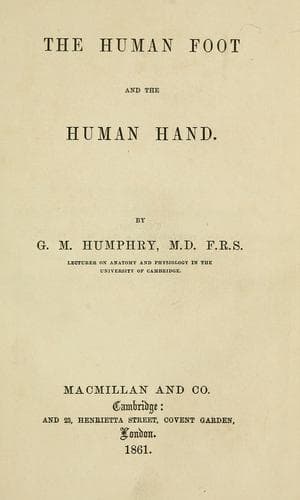
The human foot and the human handHumphry, George Murray, Sir
Science
The human foot and the human hand
Humphry, George Murray, Sir
Foot; Hand
You will estimate the value of the science of CHEIROMANCY when you
hear that equal furrows upon the lower joint of the thumb argue riches
and possessions; but a line surrounding the middle joint portends
hanging. The nails, also, came in for their share of attention: and
we are informed that, when short, they imply goodness; when long and
narrow, steadiness but dulness; when curved, rapacity. Black spots upon
them are unlucky; white are fortunate. Even at the present day Gipsies
practise the art when they can find sufficient credulity to encourage
them.
Whether any fancy of the like kind gave origin to the notion still
prevalent that a wound or injury between the thumb and the fore-finger
is peculiarly likely to be followed by LOCK-JAW, or whether the notion
was grounded on some notable instance in which that fearful malady did
actually supervene upon a wound in the situation mentioned, I cannot
tell. You may, however, rest assured, that it is quite a fallacy.
Lock-jaw may result from a wound in any part of the body, or it may
occur without a wound; it is very capricious in its attack; the surgeon
does not know when to look for it; it often shows itself when he least
expects it; but it is not more likely to follow a wound between the
thumb and the fore-finger than a wound elsewhere. I think it well to
mention this, because I have often known persons greatly alarmed when
they have accidentally cut themselves in the dreaded spot.
_Cause of the preferential use of the Right Hand._
Why is man usually <sc>RIGHT-HANDED</sc>? Many attempts have been
made to answer this question; but it has never been done quite
satisfactorily; and I do not think that a clear and distinct
explanation of the fact can be given.
There is no anatomical reason for it with which we are acquainted. The
only peculiarity that we can discern is a slight difference in the
disposition, within the chest, between the blood-vessels which supply
the right and the left arms. This, however, is quite insufficient to
account for the disparity between the two limbs. Moreover, the same
disposition is observed in left-handed persons, and in some of the
lower animals; and in none of the latter is there that difference
between the two limbs which is so general among men.
Is the superiority of the right hand real and natural, that is,
congenital? or is it merely acquired? I incline much to the latter
view; because all men are not right-handed; some are left-handed; some
are ambidextrous; and in all persons, I believe, the left hand may be
trained to as great expertness and strength as the right[9]. It is so
in those who have been deprived of their right hand in early life; and
most persons can do certain things with the left hand better than with
the right.
Public-domain text, read in full here on John Shaqi.
Reviews
Reviews
No reviews yet
Be the first to share your thoughts on this work.
Elsewhere in the archive
Join the Discussion
Join the discussion
Sign in to leave a comment or review.
Sign InorCreate an account