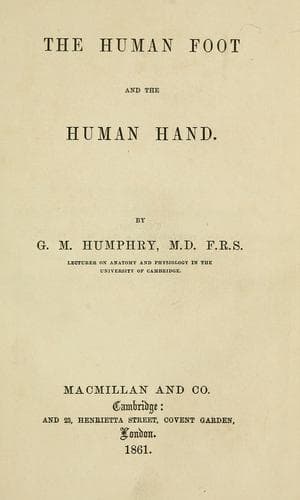
The human foot and the human handHumphry, George Murray, Sir
Science
The human foot and the human hand
Humphry, George Murray, Sir
Foot; Hand
[9] In the tribe of Benjamin “there were seven hundred chosen men
left-handed; every one could sling stones at an hair breadth, and
not miss.” Judges xx. 16. When David was at Ziklag there came to him
a company of men who “were armed with bows and could use both the
right hand and the left in hurling stones and shooting arrows out of
a bow.” 1 Chronicles xii. 2.
Nevertheless, though I think the superiority of the right hand is
acquired and is a result of its more frequent use, the tendency to use
it, in preference to the left, is so universal that it would seem to
be natural. I am driven, therefore, to the rather nice distinction,
that, though the superiority is acquired, the tendency to acquire the
superiority is natural.
It may be argued that the tendency must be based upon something
physical, and that, therefore, a tendency to superiority implies an
actual superiority. This may be so; but I do not think that we are
quite in a position to assert that it is so. We perceive that there is
a tendency to the preferential use of the right hand; but we do not
know upon what that tendency depends, and have, therefore no right to
assert that the cause of it lies in the construction of the limb or of
the parts which supply the limb with blood and nervous influence, or,
indeed, upon any strictly physical cause whatever.
It may be a tendency like that of certain animals to make their holes
and nests in particular places and in particular ways, to watch for
their prey at particular spots, to migrate in certain directions at
particular periods, and to group themselves in a particular order
during their travels. Such tendencies, or “Instincts” as they are often
called, may possibly be the result of a peculiar conformation of the
several animals; but it is, at present, by no means certain that they
are so.
I have said that man is the only animal in whom a preference in the
use of the limb or limbs of one side is shown. This is a consequence of
the fact that he is the only animal who has occasion to use the limbs
of the two sides separately, or who is in the habit of doing so. Even
in the rudest state of society this habit is engendered in him from a
very early period, as in carrying a stick, throwing a spear, and in
a variety of ways. The habit increases as he becomes more civilized,
owing to the greater number of offices which the hands are called upon
to perform; and the necessity for using the hands separately would, of
itself, lead each individual to the employment of one more frequently
than the other; but that that one should so universally be the right
hand, seems to be accounted for only by reference to some natural
tendency. The imitative propensity in man and the convenience of
uniformity of modes of action are scarcely sufficient to account for it.
Public-domain text, read in full here on John Shaqi.
Reviews
Reviews
No reviews yet
Be the first to share your thoughts on this work.
Elsewhere in the archive
Join the Discussion
Join the discussion
Sign in to leave a comment or review.
Sign InorCreate an account