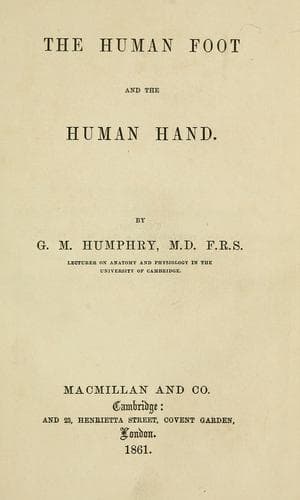
The human foot and the human handHumphry, George Murray, Sir
Science
The human foot and the human hand
Humphry, George Murray, Sir
Foot; Hand
I will not detain you by dwelling upon the effect which the
superiority of the right hand has in giving a slight superiority to the
right leg and the right eye, and will content myself with mentioning
a single beneficial result of the preferential use of one hand, viz.
that by it, we acquire a greater degree of skilfulness and dexterity
than we should do if both hands were equally employed. The exclusive
use, for instance, of the right hand in writing, cutting, &c. gives it
a greater expertness than either hand would have had if both of them
had been accustomed to perform these offices. Hence, we usually find
that persons who are left-handed are rather clumsy-fingered, because,
although, in them, the left hand is used for many purposes which are
commonly assigned to the right, yet the conventionalities of life
interfere a good deal. The pen and the knife, for instance, are still
wielded by the right hand. Accordingly such persons are neither truly
right-handed nor truly left-handed; and they do not commonly acquire
so great skill in the use of either hand as do those whose natural
tendency is more in harmony with custom.
* * * * *
The great martyr of our Church, when at the stake, is said to
have held out his right hand into the flames and to have been heard
exclaiming, till utterance was stifled, “This unworthy hand.” This
unworthy hand! Of whom or of what was that hand unworthy? Was it
unworthy of Him who made it? Was it unworthy of him who bore it? Was
it unworthy of the purposes for which it was made? Was it not, on the
contrary, a too worthy hand? a hand worthy of a better usage than to
be made, first, to sign a recantation of faith and, then, to be burned
for having done so? a hand worthy of a better man? No one would have
admitted this more readily than Cranmer. We may be sure that he would
never have thought of proclaiming a hand or any of his members to
be really unworthy of him. Rather would he have willingly confessed
that he had fallen far short of the standard of excellence which the
body presents; and in that excellence, we doubt not, he recognised
an evidence of Divine workmanship. His meaning, therefore, has not
been misunderstood. Nevertheless disparaging remarks respecting the
body, and the use of the word “carnal” in the sense in which it is
usually employed, have some tendency to excuse a shrinking from moral
responsibilities on the ground of the weakness of the flesh. Let us
remember that much of that weakness is of our own engendering, that a
moral obliquity is the source of many of those physical infirmities
which, we flatter ourselves, may cover our delinquencies, and which a
sympathising humanity is wont, perhaps too often, to throw as a shield
over offenders against the laws. In man, and in man alone of created
beings, the physical and the moral grow up together and react upon one
another; and the charge of a body thus capable of influencing and being
Public-domain text, read in full here on John Shaqi.
Reviews
Reviews
No reviews yet
Be the first to share your thoughts on this work.
Elsewhere in the archive
Join the Discussion
Join the discussion
Sign in to leave a comment or review.
Sign InorCreate an account