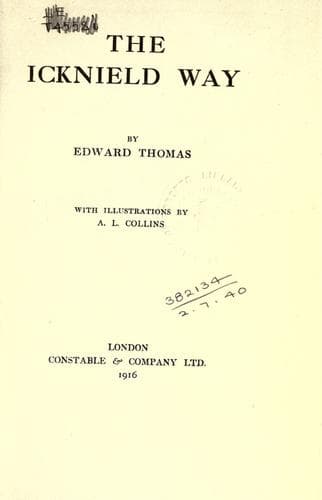
England -- Description and travel; Icknield Way (England); Thomas, Edward, 1878-1917
This, however, is only a possibility comparatively picturesque. The
real thing was less amusing, and the scene of it was not Wayland’s
Smithy but Lone Barn. That winter a man might have picked up the paper
after breakfast and found descriptions of funerals and marriages, the
well-attended presentation to the local member of Parliament, the
successful meeting of his rival, the list of hunting appointments,
and a column and a half headed, “Suffering Children--Parental
Neglect--Queer Defence--Severe Sentences--Magistrate’s Scathing
Condemnation.” A capital fox-hunter presiding, the bench had given
four months’ hard labour to a man and wife for neglecting their seven
young children “in such a way as to cause them unnecessary suffering
and injury to their health.” Having scorched his back parts the reader
would turn his front parts to the fire and read on. These nine had been
living for some weeks at Lone Barn, which lies unexpectedly in a small
hollow at one of the highest points of the downs, three miles from the
nearest hamlet. It had long been deserted. The farm-house was ruinous,
and a fox taking refuge there could not be dislodged from the fallen
masonry and elder and yew tree roots. The hunters had noticed nothing
in the barn.
I knew the farm-house and had often wondered about the man who built
it in that solitude somewhere in the eighteenth century. It had walls
of unusual thickness, such as could not have been overthrown simply
by time and weather. It must long have been empty and subject to the
hostility of discontented spirits such as probably infest a house, as
they do a man, left utterly alone. I had not suspected that anybody was
living in the barn, but I remember a pale, shuffling man carrying a
child who begged from me monotonously as I came down the hill in mist a
little before dark. I had given him something without exactly realizing
that he was a man, so frail, subdued, and weak-voiced had he been--a
creation of the mist quite in harmony with the hour. This was probably
Arthur Aubrey Bishopstone, who was now in prison.
Public-domain text, read in full here on John Shaqi.
Reviews
Reviews
No reviews yet
Be the first to share your thoughts on this work.
Elsewhere in the archive
Join the Discussion
Join the discussion
Sign in to leave a comment or review.
Sign InorCreate an account