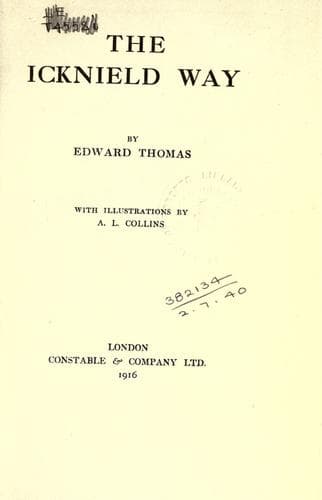
England -- Description and travel; Icknield Way (England); Thomas, Edward, 1878-1917
kingly and brave place in comparison with the infinite heavens now so
joyous and so bright and out of reach. I was glad to be there, but I
fell in with a philosopher who seemed to be equally moved yet could
not decide whether his condition was to be described as happiness or
melancholy. He talked about himself. He was a lean, indefinite man;
half his life lay behind him like a corpse, so he said, and half was
before him like a ghost. He told me of just such another evening as
this and just such another doubt as to whether it was to be put down
to the account of happiness or melancholy. He said that he had
been digging all day in a heavy soil, often jarring the fork against
immovable flints, lifting more often than not a weight of clay only
just short of the limit of his strength. He had thought and thought
until his brain could do nothing but remain aware of dull misery and
the violent shocks of the hard work. But his eyes saw the sun go down
with a brief pomp of crimson soon covered up by funereal drifts, and
these in their turn give way to a soft blue, full of whitest stars
and without one cloud. They saw the far hills once more take on their
night look of serene and desolate vastness, and felt the meadows of the
valley become dark and uncertain, the woods much duller but distinct.
The woods immediately below him on the hill-side thickened and appeared
more wild and impossible; the road winding up between them like a long
curl of smoke was wholly concealed. Slowly the solid world was whittled
away. The lights of the small town half-way across the valley, towards
the hills, came out.
[Illustration: Beacon Hill, Ivinghoe.]
As an owl in the woods announced the triumph of night with one large,
clear note, he straightened himself slowly and painfully among the
clods. It would have been easier to continue his toil than to do this,
but he did it, and then cleaned the prongs of his upright fork with the
toe of his boot, prolonging the action as if he either hoped to arrive
now at some significant conclusion with its help or feared the next
step that had to be taken. When he could no longer clean the prongs he
raised his head and looked out beyond the woods over the valley to the
far hills. The quiet, the magnitude of space, the noble lines of the
range a little strengthened his spirit. He remained still. The surface
of his hands was dry to brittleness; he was stiff and yet unsatisfied
with the result of his labour; he felt the dulness of his eyes; and no
thing or person in the world or out of it came into his mind with any
conscious delight or quickness; yet he still looked along the ridges
of the hills from one end to the other, from star to star, without a
thought save the sleeping, underlying one that he was growing old.
A motor-car climbed nervously up the invisible hill-road, the lamps of
it darting across a hundred little spaces between one tree and another
of the vague woods. It left the silence stronger than ever.
Public-domain text, read in full here on John Shaqi.
Reviews
Reviews
No reviews yet
Be the first to share your thoughts on this work.
Elsewhere in the archive
Join the Discussion
Join the discussion
Sign in to leave a comment or review.
Sign InorCreate an account