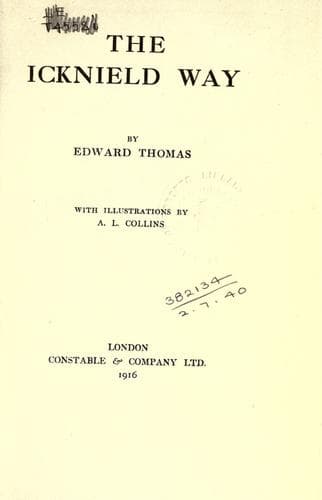
England -- Description and travel; Icknield Way (England); Thomas, Edward, 1878-1917
broad and straight through that town. Scott has one of these ghostly
old roads in _Guy Mannering_. It was over a heath that had Skiddaw and
Saddleback for background, and he calls it a _blind road_--“the track
so slightly marked by the passengers’ footsteps that it can but be
traced by a slight shade of verdure from the darker heath around it,
and, being only visible to the eye when at some distance, ceases to be
distinguished while the foot is actually treading it.”
The making of such roads seems one of the most natural operations of
man, one in which he least conflicts with nature and the animals. If
he makes roads outright and rapidly, for a definite purpose, they may
perish as rapidly, like the new roads of modern Japanese enterprise,
and their ancient predecessors live on to smile at their ambition.
These are the winding ways preferred by your connoisseur to-day. “Give
me,” says Hazlitt, “the clear blue sky over my head and the green turf
beneath my feet, a winding road before me, and a three-hours’ march
to dinner--and then to thinking!” These windings are created by the
undulating of the land, and by obstacles like those of a river--curves
such as those in the High Street of Oxford, which Wordsworth called
“the stream-like windings of that glorious street.” The least obstacle
might bring about a loop, if nothing more, and as even a Roman road
curled round Silbury Hill, so the path of the Australian savage
is to be seen twisting round bush after bush as if it enjoyed the
interruption, though it cannot purl like the river at a bend. Probably
these twists, besides being unconsciously adapted to the lie of the
land, were, as they are still, easeful and pleasant to the rover who
had some natural love of journeying. Why go straight? There is nothing
at the end of any road better than may be found beside it, though there
would be no travel did men believe it. The straight road, except over
level and open country, can only be made by those in whom extreme haste
and forethought have destroyed the power of joy, either at the end or
at any part of its course. Why, then, go straight? The connoisseur had
something of the savage in him when he demanded a winding road.
Public-domain text, read in full here on John Shaqi.
Reviews
Reviews
No reviews yet
Be the first to share your thoughts on this work.
Join the Discussion
Join the discussion
Sign in to leave a comment or review.
Sign InorCreate an account