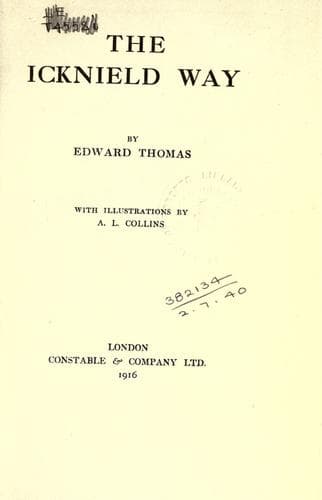
England -- Description and travel; Icknield Way (England); Thomas, Edward, 1878-1917
It is not, however, to a man walking for pleasure that we shall go for
a sense of roads, but to one like Bunyan. _Pilgrim’s Progress_ is full
of the sense of roads. See Christian going to Mr. Legality’s house.
It is a mountain road, and the hill overhangs it so much that he is
afraid to venture further “lest the hill should fall on his head.”
When Goodwill points out the narrow way, he says it was “cast up by
the patriarchs, prophets, Christ, and his Apostles,” i.e. made into a
raised track bounded by ditches from which the earth was cast up to
form the embankment. When Christian comes to the Hill Difficulty you
see the primitive man deciding to go straight uphill, turning not to
the left by the way called Danger into a great wood, nor to the right
to Destruction and the “wide field full of dark mountains.” How full
of plain English country wayfaring is the passage where Hopeful and
Christian take a road by a river-side, and then when it turns away
from the water they see a stile leading into a path which keeps on, as
a path would do, along the bank through By-path Meadow: only, as it
happens, the river is in flood and they must turn back again towards
the stile. This man knew roads, and one of his temptations after
conversion was to try his faith by bidding the puddles on the road
between his own village and Bedford to be dry. Cervantes had the sense
of roads. He begins, indeed, by making Don Quixote sally forth “upon
the plain” like any knight of chivalry “pricking o’er the plain” and
taking the way chosen by his horse because thus would adventures best
be compassed; but it is upon a road that he and most of his knights,
ladies, and enchanters travel. Malory’s book would have less vitality
in its marvel if it were not for the roads: the three highways, for
example, where Sir Marhaus and Sir Gawaine and Sir Uwaine were to
separate for their adventures each with his damosel; and the wild ways
of Sir Launcelot when he “rode many wild ways, throughout marches
and many wild ways,” until he came to a valley and a knight therein
with a naked sword chasing a lady. _Cymbeline_ again, and some of the
historical plays of Shakespeare, give a grand impression of wide tracts
of country traversed by roads of great purpose and destiny.
Public-domain text, read in full here on John Shaqi.
Reviews
Reviews
No reviews yet
Be the first to share your thoughts on this work.
Join the Discussion
Join the discussion
Sign in to leave a comment or review.
Sign InorCreate an account