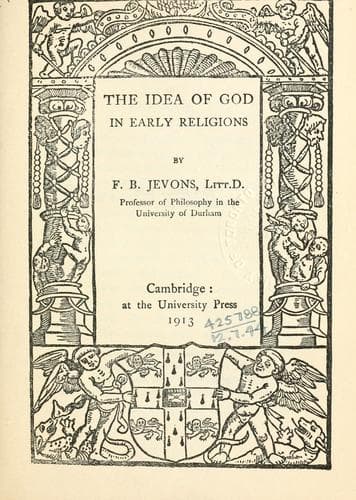
The Idea of God in Early ReligionsJevons, F. B. (Frank Byron)
Religion
The Idea of God in Early Religions
Jevons, F. B. (Frank Byron)
God; Religion
In the stage of human evolution known as animism, everything which
acts--or is supposed to act--is supposed to be, like man himself, a
person. But though, in the animistic stage, all powers are conceived
by man as being persons, they are not all conceived as having human
form: they may be animals, and have animal forms; or birds, and have
bird-form; they may be trees, clouds, streams, the wind, the
earthquake or the fire. In some, or rather in all, of these, man has
at some time found the being or the power, greater than man, of whom
he has at all times been in quest, with the enquiry, addressed to each
in turn, 'Art thou there?' The form of the question, the use of the
personal pronoun, shows that he is seeking for a person. And students
of the science of religion are generally agreed that man, throughout
the history of religion, has been seeking for a power or being
superior to man and greater than he. It is therefore a personal power
and a personal being that man has been in search of, throughout his
religious history. He has pushed his search in many directions--often
simultaneously in different directions; and, he has abandoned one line
of enquiry after another, because he has found that it did not lead
him whither he would be. Thus, as we have seen, he pushed forward, at
the same time, in the direction of fetishism and of polytheism, or
rather of polydaemonism; but fetishism failed to bring him
satisfaction, or rather failed to satisfy the common consciousness,
the consciousness of the community, because it proved on trial to
subserve the wishes--the anti-social wishes--of the individual, and
not the interests of the community. The beings or powers that man
looked to find and which he supposed he found, whether as fetishes in
this or that object, or as daemons in the sky, the fire or the wind,
in beast or bird or tree, were taken to be personal beings and
personal powers, bearing the same relation to that in which, or
through which, they manifested themselves, as man bears to his body.
They do not seem to have been conceived as being men, or the souls of
men which manifested themselves in animals or trees. At the time when
polydaemonism has, as yet, not become polytheism, the personal beings,
worshipped in this or that external form, have not as yet been
anthropomorphised. Indeed, the process which constitutes the change
from polydaemonism to polytheism consists in the process, or rather is
the process, by which the spirits, the personal beings, worshipped in
tree, or sky, or cloud, or wind, or fire came gradually to be
anthropomorphised--to be invested with human parts and passions and to
be addressed like human beings with proper names. But when
anthropomorphic polytheism is thus pushed to its extreme logical
conclusions, its tendency is to collapse in the same way, and for the
same reasons, as fetishism, before it, had collapsed. What man had
been in search of, from the beginning, and was still in search of, was
Public-domain text, read in full here on John Shaqi.
Reviews
Reviews
No reviews yet
Be the first to share your thoughts on this work.
Join the Discussion
Join the discussion
Sign in to leave a comment or review.
Sign InorCreate an account