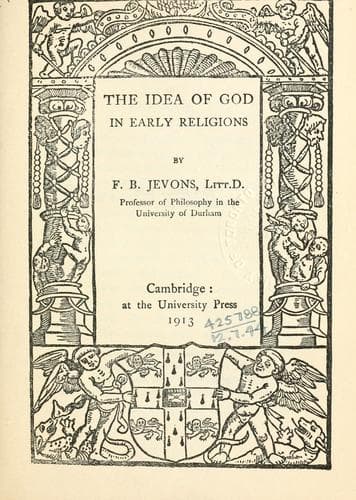
The Idea of God in Early ReligionsJevons, F. B. (Frank Byron)
Religion
The Idea of God in Early Religions
Jevons, F. B. (Frank Byron)
God; Religion
some personal being or power, higher than and superior to man. What
anthropomorphic polytheism presented him with, in the upshot, was with
beings, not superior, but, in some or many cases, undeniably inferior
to man. As such they could not thenceforth be worshipped. In Europe
their worship was overthrown by Christianity. But, on reflection, it
seems clear not only that, as such, they could not thenceforth be
worshipped; but that, as such, they never had been worshipped. In the
consciousness of the community, the object of worship had always been,
from the beginning, some personal being superior to man. The apostle
of Christianity might justifiably speak to polytheists of the God
'whom ye ignorantly worship.' It is true, and it is important to
notice, that the sacrifices and the rites and ceremonies, which
together made up the service of worship, had been consciously and
intentionally rendered to deities represented in human form; and, in
this sense, anthropomorphic deities had been worshipped. But, if
worship is something other than sacrifice and rite and ceremony, then
the object of worship--the personal being, greater than man--presented
to the common consciousness, is something other than the
anthropomorphic being, inferior in much to man, of whom poets speak in
mythology and whom artists represent in bodily shape.
Just as fetishism developed and persisted, because it did contain,
though it perverted, one element of religious truth--the accessibility
of the power worshipped to the worshipper--so too anthropomorphism,
notwithstanding the consequences to which, in mythology, it led, did
contain, or rather, was based on, one element of truth, viz. that the
divine is personal, as well as the human. Its error was to set up, as
divine personalities, a number of reproductions or reflections of
human personality. It leads to the conclusion, as a necessary
consequence, that the divine personality is but a shadow of the human
personality, enlarged and projected, so to speak, upon the clouds, but
always betraying, in some way or other, the fact that it is but the
shadow, magnified or distorted, of man. It excludes the possibility
that the divine personality, present to the common consciousness as
the object of worship, may be no reproduction of the human
personality, but a reality to which the human personality has the
power of approximating. Be this as it may, we are justified in saying,
indeed we are compelled to recognise, that in mythology, all the world
over, we see a process of reflection at work, by which the beings,
originally apprehended as superior to man, come first to be
anthropomorphised, that is to be apprehended as having the parts and
passions of men, and then, consequently, to be seen to be no better
than men. This discovery it is which in the long run proves fatal to
anthropomorphism.
Public-domain text, read in full here on John Shaqi.
Reviews
Reviews
No reviews yet
Be the first to share your thoughts on this work.
Join the Discussion
Join the discussion
Sign in to leave a comment or review.
Sign InorCreate an account