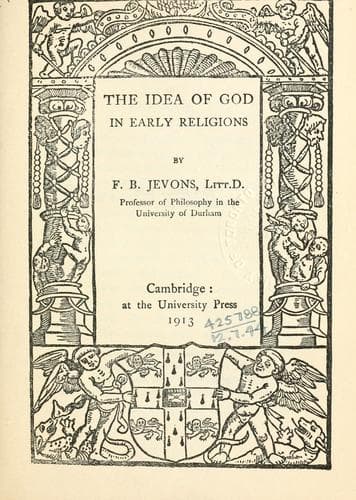
The Idea of God in Early ReligionsJevons, F. B. (Frank Byron)
Religion
The Idea of God in Early Religions
Jevons, F. B. (Frank Byron)
God; Religion
The course of history has shown, as a matter of fact, that these
repulsive and disgusting myths could not be rooted out without
uprooting the whole system of mythology. But the course of history has
also shown that religion could continue to exist after the destruction
of mythology, as it had done before its birth. But, of this the
generations to whom myths had been transmitted and for whom mythology
was the accepted belief, could not be aware. In their eyes the attempt
to discredit some myths appeared to involve--as it did really
involve--the overthrow of the whole system of mythology. If they
thought--as they undoubtedly did think--that the destruction of
mythology was the same thing as the destruction of religion, their
error was one of a class of errors into which the human mind is at no
time exempt from falling. And they had this further excuse, that the
destruction of mythology did logically and necessarily imply the
destruction of polytheism. Polytheism and mythology were complementary
parts of their idea of the Godhead. Demonstrations therefore of the
inconsistency and immorality involved in their idea were purely
negative and destructive; and they were, accordingly, unavailing until
a higher idea of the unity of the Godhead was forthcoming.
Until that time, polytheism and mythology struggled on. They were
burdened, and, as time went on, they were overburdened, with the
weight of the repulsive myths which could not be denied and disowned,
but could only be thrust out of sight as far, and as long, as
possible. These myths, however offensive they became in the long run
to the conscience of the community, were, in their origin, narratives
which were not offensive to the common consciousness, for the simple
reason that they were the work of the common consciousness, approved
by it and transmitted for ages under the seal of its approval. If they
were not offensive to the common consciousness at the time when they
originated, and only became so later, the reason is that the morality
of the community was less developed at the time of their origin than
it came to be subsequently. If they became offensive, it was because
the morality of the community tended to advance, while they remained
what they had always been.
Public-domain text, read in full here on John Shaqi.
Reviews
Reviews
No reviews yet
Be the first to share your thoughts on this work.
Join the Discussion
Join the discussion
Sign in to leave a comment or review.
Sign InorCreate an account