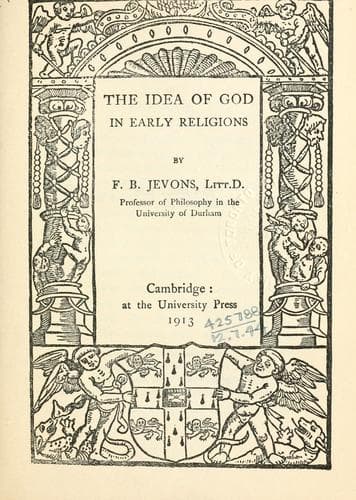
The Idea of God in Early ReligionsJevons, F. B. (Frank Byron)
Religion
The Idea of God in Early Religions
Jevons, F. B. (Frank Byron)
God; Religion
It may, perhaps, be asked, why the morality of the community should
tend to change, and the myths of the community should not? The reason
seems to be that myths are learned by the child in the nursery, and
morality is learned by the man in the world. The family is a smaller
community than the village community, the city, or the state; and the
smaller the community, the more tenacious it is of its customs and
traditions. The toys of Athenian children, which have been discovered,
are, all, the toys which children continue to use to this day. In the
Iliad children built sand-castles on the sea-shore as they do now; and
the little child tugged at its mother's dress then as now. Children
then as now would insist that the tales told to them should always be
told exactly as they were first told. Of the discrepancy between the
morality exhibited by the heroes of nursery-tales and that practised
by the grown-up world the child has no knowledge, for the sufficient
reason that he is not as yet one of the grown-up world. When he enters
the grown-up world, he may learn the difference; but he can only enter
the grown-up world, if there is one for him to enter; and, in the
childhood of man, there is none which he can enter, for the adults
themselves, though of larger growth, are children still in mind.
Custom and tradition rule the adult community then as absolutely as
they rule the child community. In course of time, the adult community
may break the bonds of custom and tradition; but the community which
consists of children treasures them and hands them on. Within the
tribe, thenceforth, there are two communities, that of the adults and
that of the children. The one community is as continuous with itself
as the other; but the children's community is highly conservative of
what it has received and of what it hands on--and that for the simple
reason that children will be children still. It is this homogeneity of
the children's community which enables it to preserve its customs,
traditions and beliefs. And as long as the community of adults is
homogeneous, it also departs but little from the customs, traditions
and beliefs, which it has inherited from the same source as the
children's community has inherited them. The two communities, the
children's and the adults', originate and develop within the larger
community of the tribe. They differentiate, at first, with exceeding
slowness; the children's community changes more slowly even than the
adults'--its weapons continue to be the bow and arrow, long after
adults have discarded them; and the bull-roarer continues sacred in
its eyes to a period when the adult community has not only discarded
its use but forgotten its meaning. In its tales and myths it may
preserve the memory of a stage of morality which the adult community
has outgrown, and has left behind as far it has left behind the
bull-roarer or the bow and arrow. And the stage of morality, of which
Public-domain text, read in full here on John Shaqi.
Reviews
Reviews
No reviews yet
Be the first to share your thoughts on this work.
Join the Discussion
Join the discussion
Sign in to leave a comment or review.
Sign InorCreate an account