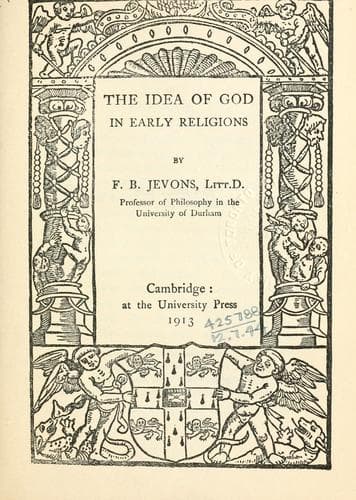
The Idea of God in Early ReligionsJevons, F. B. (Frank Byron)
Religion
The Idea of God in Early Religions
Jevons, F. B. (Frank Byron)
God; Religion
it preserves the memory, is one from which the adult community in past
time emerged. Having emerged, indeed, it found itself, eventually,
when made to look back, compelled to condemn that which it looked back
upon.
What, then, were these myths, with which the moralised community might
find itself confronted? They were tales which originated in the mind
of the community when it was yet immature. They preserve to us the
reflections of the immature mind about the gods and what they did. And
it is because the minds, which made these reflections, were immature,
that the myths which embodied or expressed these reflections, were
such as might be accepted by immature minds, but were eventually found
intolerable by more mature minds. It may, perhaps, be said--and it may
be said with justice--that the reflections even of the immature mind
are not all, of necessity, erroneous, for it is from them that the
whole of modern knowledge has been evolved or developed, just as the
steam-plough may be traced back to the primitive digging-stick:
reflection upon anything may lead to better knowledge of the thing, as
well as to false notions about it. But the nations, which have
outgrown mythology, have cast it aside because in the long run they
became convinced that the notions it embodied were false notions. And
they reached that conclusion on this point in the same way and for
the same reason as they reached the same conclusion in other matters;
for there is only one way. There is only one way and one test by which
it is possible to determine whether the inferences we have drawn about
a thing are true or false, and that is the test of experience. That
alone can settle the question whether the thing actually does or does
not act in the way, or display the qualities alleged. If it proves in
our experience to act in the way, or to display the qualities, which
our reflection led us to surmise, then our conception of the thing is
both corrected and enlarged, that is to say, the thing proves to be
both more and other than it was at first supposed to be. If experience
shows that it is not what we surmised, does not act in the way or
display the qualities our reflection led us to expect, then, as the
conclusions we reached are wrong, our reflections were on a wrong
line, and must have started from a false conception or an imperfect
idea of the thing.
Public-domain text, read in full here on John Shaqi.
Reviews
Reviews
No reviews yet
Be the first to share your thoughts on this work.
Join the Discussion
Join the discussion
Sign in to leave a comment or review.
Sign InorCreate an account