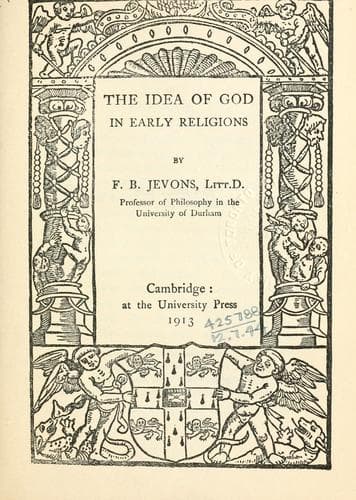
The Idea of God in Early ReligionsJevons, F. B. (Frank Byron)
Religion
The Idea of God in Early Religions
Jevons, F. B. (Frank Byron)
God; Religion
But the question, 'Why did the god do it?' is susceptible, on
reflection, of another kind of answer. And from minds of a more
reflective cast than the Roman, it received answer in the form of
mythology, of aetiological myths. Mythology is the work of reflection:
it is when the community has time and inclination to reflect upon its
gods and their doings that mythology arises in the common
consciousness. For everything which happens to him, early man has one
explanation, if the thing is such as seems to him to require
explanation, and the explanation is that this thing is the doing of
some god. If the thing that arrests attention is some disaster, which
calls for remedy, the community approaches the god with prayer and
sacrifice; its object is practical, not speculative; and no myth
arises. But if the thing that arrests attention is not one which calls
for action, on the part of the community, but one which stimulates
curiosity and provokes reflection, then the reflective answer to the
question, why has this thing been done by whatever god that did it, is
a myth.
Thus the mood, or state of mind, in which mythology originates is
clearly different from that in which the community approaches its
offended gods for the purpose of appeasing them. The purpose in the
latter case is atonement and reconciliation. The state of mind in the
former case is one of enquiry. The emotion, of mingled fear and hope,
which constitutes the one state of mind, is clearly different from the
spirit of enquiry which characterises and constitutes the other state
of mind. The one mood is undeniably religious; the other, not so. In
the one mood, the community feels itself to be in the presence of its
gods; in the other it is reflecting and enquiring about them. In the
one case the community appears before its god; in the other it is
reflectively using its idea of god, for the purpose of explaining
things that call for explanation. But the idea of God, when used in
this way, for the purpose of explaining things by means of myths, is
modified by the use it is put to. It is not merely that everything
which happens is explained, if it requires explanation, as the doing
of some god; but the motives which early man ascribed, in his
mythological moments, to the gods--motives which only undeveloped man
could have ascribed to them--became part of the idea of God on which
mythology worked and with which myths had to do. The idea of god thus
gradually developed in polytheistic myths, the accumulated reflections
of savage, barbarous and semi-barbarous ancestors, tends eventually to
provoke reaction. But why? Not merely because the myths are immoral
and irrational. But because of the essential impiety of imputing
immoral and irrational acts to the divine personality. Plainly, then,
those thinkers and writers who were painfully impressed by such
impiety, who were acutely conscious that divine personality was
irreconcilable with immorality and irrationality, had some other idea
Public-domain text, read in full here on John Shaqi.
Reviews
Reviews
No reviews yet
Be the first to share your thoughts on this work.
Join the Discussion
Join the discussion
Sign in to leave a comment or review.
Sign InorCreate an account