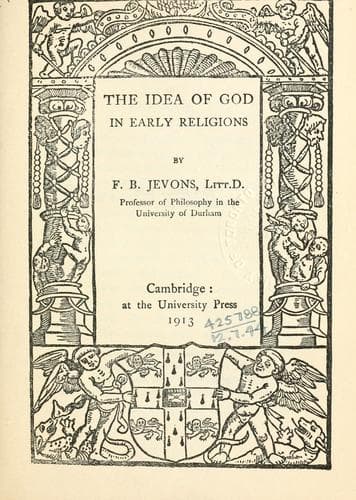
The Idea of God in Early ReligionsJevons, F. B. (Frank Byron)
Religion
The Idea of God in Early Religions
Jevons, F. B. (Frank Byron)
God; Religion
of God than the mythological. We may go further: we may safely say
that the average man would not have been perturbed, as he was, by
Socrates, for instance, had he, also, not found within him some other
idea of God than the mythological. And we can understand, to some
extent, how this should be, if we call to mind that, though mythology
grows and luxuriates, still the worship of the gods goes on. That is
to say, the community, through it all, continues to approach its gods,
for the purpose, and with the emotion of mingled fear and hope, with
which it had always come into the presence of its gods. It is the
irreconcilability of the mood of emotion, which is essentially
religious, with the mythological mode of reflective thought, which is
not, that tends to bring about the religious reaction against
mythology. It is not however until the divergence between religion
and mythology has become considerable that the irreconcilability
becomes manifest. And it is in the experience of some individual, and
not in the common consciousness, that this irreconcilability is first
discovered. That discovery it is which makes the discoverer realise
that it is not merely when he comes before the presence of his gods in
their temples, but that, whenever his heart rises on the tide of
mingled fear, hope and thanksgiving, he comes into the presence of his
God. Having sought for the divine personality in all the external
objects of the world around him in the end he learns, what was the
truth from the beginning,--that it is in his heart he has access to
his God.
Public-domain text, read in full here on John Shaqi.
Reviews
Reviews
No reviews yet
Be the first to share your thoughts on this work.
Join the Discussion
Join the discussion
Sign in to leave a comment or review.
Sign InorCreate an account