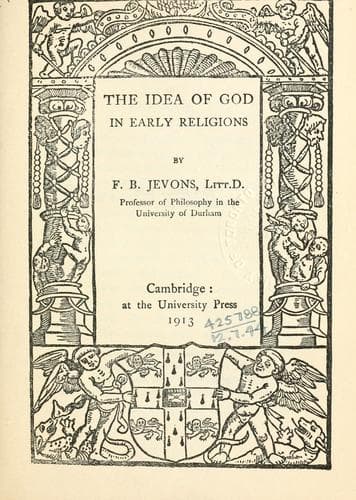
The Idea of God in Early ReligionsJevons, F. B. (Frank Byron)
Religion
The Idea of God in Early Religions
Jevons, F. B. (Frank Byron)
God; Religion
When, however, we take his prayers as the evidence from which to infer
his idea of God, instead of the luxuriant overgrowth of speculative
mythology, we find everywhere a bare simplicity, and everywhere
substantial identity. If this is contrary to our expectation and at
first seems strange, let us bear in mind that the science of morals
offers a parallel, in this respect, to the science of religion. At one
time it was, unconsciously but none the less decidedly, assumed that
savages had a multiplicity of irrational and disgusting customs but no
morals. The idea that there could be a substantial identity between
the moral rules of different savage races, and even between their
moral rules and ours, was an idea that simply was not entertained.
Nevertheless, it was a fact, though unnoticed; and now it is a fact
which, thanks to Dr Westermarck, is placed beyond dispute. 'When,' he
says, 'we examine the moral rules of uncivilised races we find that
they in a very large measure resemble those prevalent among nations
of culture.' The human spirit throughout the process of its evolution
is, in truth, one; the underlying unity which manifests itself
throughout the evolution of morality is to be found also in the
evolution of religion; and it is from the prayers of man that we can
infer it.
The first and fundamental article of belief implied by the offering of
prayers is that the being to whom they are offered--however vaguely he
may be conceived--is believed to be accessible to man. Man's cry can
reach Him. Not only does it reach Him but, it is believed, He will
listen to it; and it is of His very nature that He is disposed to
listen favourably to it. But, though He will listen, it is only to
prayers offered in the right spirit that He will listen. The earliest
prayers offered are in all probability those which the community sends
up in time of trouble; and they must be offered in the spirit of
repentance. It is with the conviction that they have offended that the
community first turns to the being worshipped, by whom they hope to be
delivered from the evil which is upon them, and by whom they pray to
be forgiven.
Next, the offering of prayer implies the belief that the being
addressed, not merely understands the prayers offered, but has the
power to grant them. As having not only the power, but also the will
so to do, he is approached not only with fear but also with hope. No
approach would or could be made, if nothing could be hoped from it;
and nothing could be hoped, unless the being approached were believed
to have the power to grant the prayer. The very fact that approach is
made shows that the being is at the moment believed to be one with
whom it rests to grant or refuse the supplication, one than whom no
other is, in this respect at least, more powerful, _quo nihil maius_.
Public-domain text, read in full here on John Shaqi.
Reviews
Reviews
No reviews yet
Be the first to share your thoughts on this work.
Elsewhere in the archive
Join the Discussion
Join the discussion
Sign in to leave a comment or review.
Sign InorCreate an account