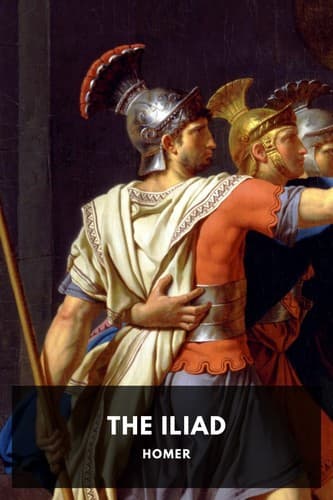
Achilles (Mythological character); Epic poetry, Greek -- Translations into English; Trojan War
Footnote 17: (return) I have used “Greeks” wherever the whole army is
evidently meant. In other instances I have retained the specific names
of the different confederate nations.
And upon this, the blameless prophet then took confidence, and spoke:
“Neither is he enraged on account of a vow [unperformed], nor of a
hecatomb [unoffered], but on account of his priest, whom Agamemnon
dishonoured; neither did he liberate his daughter, nor did he receive
her ransom. Wherefore has the Far-darter given woes, and still will he
give them; nor will he withhold his heavy hands from the pestilence,
before that [Agamemnon] restore to her dear father the bright-eyed 18
maid, unpurchased, unransomed, and conduct a sacred hecatomb to Chrysa;
then, perhaps, having appeased, we might persuade him.”
Footnote 18: (return) See Arnold.
He indeed, having thus spoken, sat down. But to them arose the hero,
the son of Atreus, wide-ruling Agamemnon, 19 agitated; and his
all-gloomy heart was greatly filled with wrath, and his eyes were like
unto gleaming fire. Sternly regarding Calchas most of all, he addressed
[him]:
“Prophet of ills, not at any time hast thou spoken anything good for
me; but evils are always gratifying to thy soul to prophesy, 20 and
never yet hast thou offered one good word, nor accomplished [one]. And
now, prophesying amongst the Greeks, thou haranguest that forsooth the
Far-darter works griefs to them upon this account, because I was
unwilling to accept the splendid ransom of the virgin daughter of
Chryses, since I much prefer to have her at home; and my reason is, I
prefer her even to Clytemnestra, my lawful wife; for she is not
inferior to her, either in person, or in figure, or in mind, or by any
means in accomplishments. But even thus I am willing to restore her, if
it be better; for I wish the people to be safe rather than to perish.
But do thou immediately prepare a prize for me, that I may not alone,
of the Argives, be without a prize; since it is not fitting. For ye all
see this, that my prize is going elsewhere.”
Footnote 19: (return) “In the assembly of the people, as in the courts
of justice, the nobles alone speak, advise, and decide, whilst the
people merely listen to their ordinances and decisions, in order to
regulate their own conduct accordingly; being suffered, indeed, to
follow the natural impulse of evincing, to a certain extent, their
approbation or disapprobation of their superiors, but without any legal
means of giving validity to their opinion.” Müller, Gk. Lit. p. 30.
Footnote 20: (return) But we must not join μαντεύεσθαι with
κικά.—Nägelsbach.
Public-domain text, read in full here on John Shaqi.
Reviews
Reviews
No reviews yet
Be the first to share your thoughts on this work.
Join the Discussion
Join the discussion
Sign in to leave a comment or review.
Sign InorCreate an account