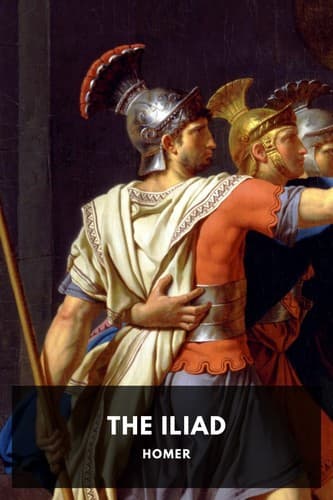
Achilles (Mythological character); Epic poetry, Greek -- Translations into English; Trojan War
“O son of Atreus! now do I think that we would consent to return,
having been defeated in our purpose, if we should but escape death,
since at the same time 11 war and pestilence subdue the Greeks. But
come now, let us consult some prophet, or priest, or even one who is
informed by dreams (for dream also is from Jove), 12 who would tell us
on what account Phoebus Apollo is so much enraged with us: whether he
blames us on account of a vow [unperformed], or a hecatomb [unoffered];
and whether haply he may be willing, having partaken of the savour of
lambs and unblemished goats, to avert from us the pestilence.”
Footnote 9: (return) The force of ἄρα is noticed by Nägelsbach.
Footnote 10: (return) Or “white.” Hesych. ταχεῖς, λευκούς.
Footnote 11: (return) Ammonius, p. 14, foolishly supposes that ἁμοῦ
here denotes place, ἰν Τροίᾳ. Valcknaer justly supports the ordinary
interpretation.
Footnote 12: (return) Cf. Plin. Ep. i. 18, and Duport, Gnom. Hom. p.
3, sq.
He indeed, thus having spoken, sat down; but to them there arose by far
the best of augurs, Calchas, son of Thestor, who knew the present, the
future, and the past, 13 and who guided the ships of the Greeks to
Ilium, by his prophetic art, which Phoebus Apollo gave him, who, being
well disposed, 14 addressed them, and said:
“O Achilles, dear to Jove, thou biddest me to declare the wrath of
Apollo, the far-darting king. Therefore will I declare it; but do thou
on thy part covenant, and swear to me, that thou wilt promptly assist
me in word and hand. For methinks I shall irritate a man who widely
rules over all the Argives, and whom the Greeks obey. For a king is
more powerful 15 when he is enraged with an inferior man; for though he
may repress his wrath 16 for that same day, yet he afterwards retains
his anger in his heart, until he accomplishes it; but do thou consider
whether thou wilt protect me.”
But him swift-footed Achilles, answering, addressed: “Taking full
confidence, declare the divine oracle, whatsoever thou knowest. For, by
Apollo, dear to Jove, to whom thou, praying, O Calchas, dost disclose
predictions to the Greeks, no one of all the Greeks, while I am alive
and have sight upon the earth, shall lay heavy hands upon thee at the
hollow ships; not even if thou wast to name Agamemnon, who now boasts
himself to be much the most powerful of the Greeks.” 17
Footnote 13: (return) A common formula in the ancient poets to express
the eternity of things. Empedocles apud Pseud. Arist. de Mundo: άνθ’
ὅσα τ’ ὴν, ὅσα τ’ εστὶ, καὶ ὄσσα τε ἔσται ὀπίσσω. Virg. Georg. iv. 392:
“Novit namque omnia vates, Quæ sint, quæ fuerint, quæ mox ventura
trahantur”.
Footnote 14: (return) See Abresch. on Æschyl. p. 287. Ernesti.
Footnote 15: (return) ἀγανακτοῦσί γἀρ διὰ τὴν ὑπεροχήν. A—rist. Rhet.
ii. 2, quoting this verse.
Footnote 16: (return) Lit. “digest his bile”. Homer’s distinction
between χόλος and κότος is observed by Nemesius, de Nat. Hom. § 21.
Public-domain text, read in full here on John Shaqi.
Reviews
Reviews
No reviews yet
Be the first to share your thoughts on this work.
Join the Discussion
Join the discussion
Sign in to leave a comment or review.
Sign InorCreate an account