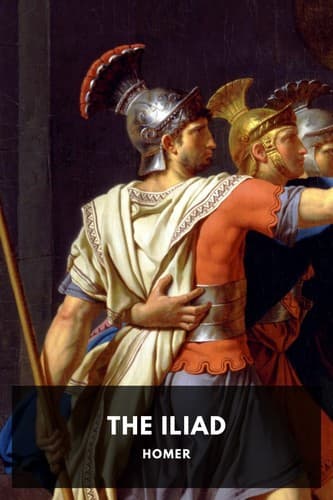
Achilles (Mythological character); Epic poetry, Greek -- Translations into English; Trojan War
But him swift-footed Achilles sternly regarding, addressed: “Ha! 25
thou clad in impudence, thou bent on gain, how can any of the Greeks
willingly obey thy orders, either to undertake a mission, or to fight
bravely with men? For I did not come hither to fight on account of the
warlike Trojans, seeing that they are blameless as respects me. Since
they have never driven away my oxen, nor my horses either nor ever
injured my crops in fertile and populous Phthia: for very many shadowy
mountains, and the resounding sea, are between us. But thee, O most
shameless man, we follow, that thou mayest rejoice; seeking
satisfaction from the Trojans for Menelaus, and for thy pleasure,
shameless one! for which things thou hast neither respect nor care. And
now thou hast threatened that thou wilt in person wrest from me my
prize, for which I have toiled much, and which the sons of the Greeks
have given me. Whenever the Greeks sacked a well-inhabited city of the
Trojans, I never have had a prize equal to thine; although my hands
perform the greater portion of the tumultuous conflict, yet when the
division [of spoil] may come, a much greater prize is given to thee,
while I come to my ships, when I am fatigued with fighting, having one
small and agreeable. But now I will go to Phthia, for it is much better
to return home with our curved ships; for I do not think that thou
shalt amass wealth and treasures while I am dishonoured here.”
Footnote 25: (return) See my note on Od. i. p. 2, n. 11, ed. Bohn.
But him, the king of men, Agamemnon, then answered: “Fly, by all means,
if thy mind urges thee; nor will I entreat thee to remain on my
account: there are others with me who will honour me, but chiefly the
all-wise Jove. For to me thou art the most odious of the Jove-nourished
princes, for ever is contention agreeable to thee, and wars and
battles. If thou be very bold, why doubtless a deity has given this to
thee. Going home with thy ships and thy companions, rule over the
Myrmidons; for I do not regard thee, nor care for thee in thy wrath;
but thus will I threaten thee: Since Phoebus Apollo is depriving me of
the daughter of Chryses, 26 her indeed I will send, with my own ship,
and with my own friends; but I myself, going to thy tent, will lead
away the fair-cheeked daughter of Brises, 27 thy prize; that thou
mayest well know how much more powerful I am than thou, and that
another may dread to pronounce himself equal to me, and to liken
himself openly [to me].”
Footnote 26: (return) Astynome. Cf. Eustath. fol. 58.
Footnote 27: (return) Hippodameia.
Public-domain text, read in full here on John Shaqi.
Reviews
Reviews
No reviews yet
Be the first to share your thoughts on this work.
Join the Discussion
Join the discussion
Sign in to leave a comment or review.
Sign InorCreate an account