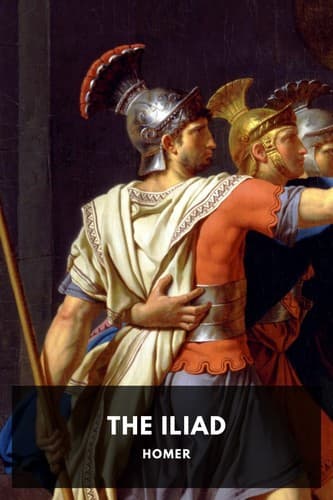
Achilles (Mythological character); Epic poetry, Greek -- Translations into English; Trojan War
Thus he spoke, and grief arose to the son of Peleus, and the heart
within, in his hairy breast, was pondering upon two courses; whether,
drawing his sharp sword from his thigh, he should dismiss them, 28 and
should kill the son of Atreus, or should put a stop to his wrath, and
restrain his passion. While he was thus pondering in his heart and
soul, and was drawing his mighty sword from the scabbard, came Minerva
from heaven; for her the white-armed goddess Juno had sent forward,
equally loving and regarding both from her soul. And she stood behind,
and caught the son of Peleus by his yellow hair, appearing to him
alone; but none of the others beheld her. But Achilles was amazed, and
turned himself round, and immediately recognized Pallas Minerva; and
awe-inspiring her eyes appeared to him. And addressing her, he spoke
winged words:
“Why, O offspring of ægis-bearing Jove, hast thou come hither? Is it
that thou mayest witness the insolence of Agamemnon, the son of Atreus?
But I tell thee, what I think will be accomplished, that he will
probably soon lose his life by his haughtiness.”
Footnote 28: (return) The princes assembled.
But him in turn the azure-eyed goddess Minerva addressed: “I came from
heaven to assuage thy wrath, if thou wilt obey me; for the white-armed
goddess Juno sent me forward, equally loving and regarding both from
her soul. But come, cease from strife, nor draw the sword with thine
hand. But reproach by words, as the occasion may suggest; for thus I
declare, and it shall be accomplished, that thrice as many splendid
gifts shall be presented to thee, because of this insolent act; only
restrain thyself, and obey us.”
But her answering, 29 swift-footed Achilles addressed: “It behoves me
to observe the command of you both, O goddess, although much enraged in
my soul; for so it is better. Whosoever obeys the gods, to him they
hearken propitiously.”
Footnote 29: (return) Columna on Ennius, p. 17, ed. Hessel., compares
“Ollei respondet Rex Albaï longaï,” and “Ollei respondet suavis sonus
Egeriäi,” observing that this formula was probably as common in the
heroic annals of Ennius as τὸν δ’ ὰπαμειξόμενος is in Homer.
He spoke, and held still his heavy hand upon the silvery hilt, and
thrust back the great sword into the scabbard, nor did he disobey the
mandate of Minerva; but she had gone to Olympus, to the mansions of
ægis-bearing Jove, amongst the other deities. But the son of Peleus
again addressed Atrides with injurious 30 words, nor as yet ceased from
anger:
Public-domain text, read in full here on John Shaqi.
Reviews
Reviews
No reviews yet
Be the first to share your thoughts on this work.
Join the Discussion
Join the discussion
Sign in to leave a comment or review.
Sign InorCreate an account