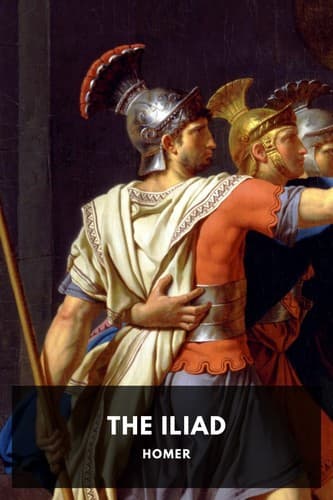
Achilles (Mythological character); Epic poetry, Greek -- Translations into English; Trojan War
Then dying spake unto him Hector of the glancing helm: “Verily I know
thee and behold thee as thou art, nor was I destined to persuade thee;
truly thy heart is iron in thy breast. Take heed now lest I draw upon
thee wrath of gods, in the day when Paris and Phoebus Apollo slay thee,
for all thy valour, at the Skaian gate.”
He ended, and the shadow of death came down upon him, and his soul flew
forth of his limbs and was gone to the house of Hades, wailing her
fate, leaving her vigour and youth. Then to the dead man spake noble
Achilles: “Die: for my death, I will accept it whensoever Zeus and the
other immortal gods are minded to accomplish it.”
He said, and from the corpse drew forth his bronze spear, and set it
aside, and stripped the bloody armour from the shoulders. And other
sons of Achaians ran up around, who gazed upon the stature and
marvellous goodliness of Hector. Nor did any stand by but wounded him,
and thus would many a man say looking toward his neighbour: “Go to, of
a truth far easier to handle is Hector now than when he burnt the ships
with blazing fire.” Thus would many a man say, and wound him as he
stood hard by. And when fleet noble Achilles had despoiled him, he
stood up among the Achaians and spake winged words: “Friends, chiefs
and counsellors of the Argives, since the gods have vouchsafed us to
vanquish this man who hath done us more evil than all the rest
together, come let us make trial in arms round about the city, that we
may know somewhat of the Trojans’ purpose, whether since he hath fallen
they will forsake the citadel, or whether they are minded to abide,
albeit Hector is no more. But wherefore doth my heart debate thus?
There lieth by the ships a dead man unbewailed, unburied, Patroklos;
him will I not forget, while I abide among the living and my knees can
stir. Nay if even in the house of Hades the dead forget their dead, yet
will I even there be mindful of my dear comrade. But come, ye sons of
the Achaians, let us now, singing our song of victory, go back to the
hollow ships and take with us our foe. Great glory have we won; we have
slain the noble Hector, unto whom the Trojans prayed throughout their
city, as he had been a god.”
He said, and devised foul entreatment of noble Hector. The tendons of
both feet behind he slit from heel to ankle-joint, and thrust
therethrough thongs of ox-hide, and bound him to his chariot, leaving
his head to trail. And when he had mounted the chariot and lifted
therein the famous armour, he lashed his horses to speed, and they
nothing loth flew on. And dust rose around him that was dragged, and
his dark hair flowed loose on either side, and in the dust lay all his
once fair head, for now had Zeus given him over to his foes to entreat
foully in his own native land.
Public-domain text, read in full here on John Shaqi.
Reviews
Reviews
No reviews yet
Be the first to share your thoughts on this work.
Elsewhere in the archive
Join the Discussion
Join the discussion
Sign in to leave a comment or review.
Sign InorCreate an account