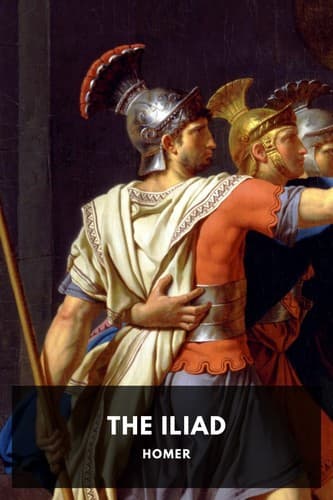
Achilles (Mythological character) -- Poetry; Classical literature; Epic poetry, Greek -- Translations into English; Trojan War -- Poetry
If we observe his descriptions, images, and similes, we shall find the
invention still predominant. To what else can we ascribe that vast
comprehension of images of every sort, where we see each circumstance
of art, and individual of nature, summoned together by the extent and
fecundity of his imagination to which all things, in their various
views presented themselves in an instant, and had their impressions
taken off to perfection at a heat? Nay, he not only gives us the full
prospects of things, but several unexpected peculiarities and side
views, unobserved by any painter but Homer. Nothing is so surprising as
the descriptions of his battles, which take up no less than half the
Iliad, and are supplied with so vast a variety of incidents, that no
one bears a likeness to another; such different kinds of deaths, that
no two heroes are wounded in the same manner, and such a profusion of
noble ideas, that every battle rises above the last in greatness,
horror, and confusion. It is certain there is not near that number of
images and descriptions in any epic poet, though every one has assisted
himself with a great quantity out of him; and it is evident of Virgil
especially, that he has scarce any comparisons which are not drawn from
his master.
If we descend from hence to the expression, we see the bright
imagination of Homer shining out in the most enlivened forms of it. We
acknowledge him the father of poetical diction; the first who taught
that “language of the gods” to men. His expression is like the
colouring of some great masters, which discovers itself to be laid on
boldly, and executed with rapidity. It is, indeed, the strongest and
most glowing imaginable, and touched with the greatest spirit.
Aristotle had reason to say, he was the only poet who had found out
“living words;” there are in him more daring figures and metaphors than
in any good author whatever. An arrow is “impatient” to be on the wing,
a weapon “thirsts” to drink the blood of an enemy, and the like, yet
his expression is never too big for the sense, but justly great in
proportion to it. It is the sentiment that swells and fills out the
diction, which rises with it, and forms itself about it, for in the
same degree that a thought is warmer, an expression will be brighter,
as that is more strong, this will become more perspicuous; like glass
in the furnace, which grows to a greater magnitude, and refines to a
greater clearness, only as the breath within is more powerful, and the
heat more intense.
Public-domain text, read in full here on John Shaqi.
Reviews
Reviews
No reviews yet
Be the first to share your thoughts on this work.
Join the Discussion
Join the discussion
Sign in to leave a comment or review.
Sign InorCreate an account