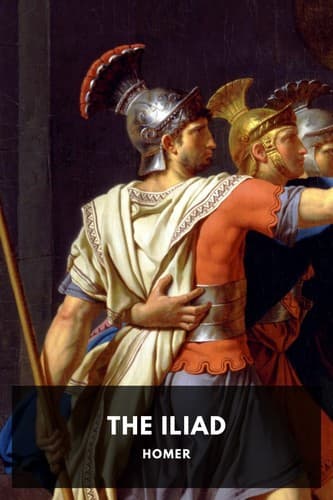
Achilles (Mythological character) -- Poetry; Classical literature; Epic poetry, Greek -- Translations into English; Trojan War -- Poetry
To throw his language more out of prose, Homer seems to have affected
the compound epithets. This was a sort of composition peculiarly proper
to poetry, not only as it heightened the diction, but as it assisted
and filled the numbers with greater sound and pomp, and likewise
conduced in some measure to thicken the images. On this last
consideration I cannot but attribute these also to the fruitfulness of
his invention, since (as he has managed them) they are a sort of
supernumerary pictures of the persons or things to which they were
joined. We see the motion of Hector’s plumes in the epithet
Κορυθαίολος, the landscape of Mount Neritus in that of Εἰνοσίφυλλος,
and so of others, which particular images could not have been insisted
upon so long as to express them in a description (though but of a
single line) without diverting the reader too much from the principal
action or figure. As a metaphor is a short simile, one of these
epithets is a short description.
Lastly, if we consider his versification, we shall be sensible what a
share of praise is due to his invention in that also. He was not
satisfied with his language as he found it settled in any one part of
Greece, but searched through its different dialects with this
particular view, to beautify and perfect his numbers he considered
these as they had a greater mixture of vowels or consonants, and
accordingly employed them as the verse required either a greater
smoothness or strength. What he most affected was the Ionic, which has
a peculiar sweetness, from its never using contractions, and from its
custom of resolving the diphthongs into two syllables, so as to make
the words open themselves with a more spreading and sonorous fluency.
With this he mingled the Attic contractions, the broader Doric, and the
feebler Æolic, which often rejects its aspirate, or takes off its
accent, and completed this variety by altering some letters with the
licence of poetry. Thus his measures, instead of being fetters to his
sense, were always in readiness to run along with the warmth of his
rapture, and even to give a further representation of his notions, in
the correspondence of their sounds to what they signified. Out of all
these he has derived that harmony which makes us confess he had not
only the richest head, but the finest ear in the world. This is so
great a truth, that whoever will but consult the tune of his verses,
even without understanding them (with the same sort of diligence as we
daily see practised in the case of Italian operas), will find more
sweetness, variety, and majesty of sound, than in any other language of
poetry. The beauty of his numbers is allowed by the critics to be
copied but faintly by Virgil himself, though they are so just as to
ascribe it to the nature of the Latin tongue: indeed the Greek has some
advantages both from the natural sound of its words, and the turn and
cadence of its verse, which agree with the genius of no other language.
Public-domain text, read in full here on John Shaqi.
Reviews
Reviews
No reviews yet
Be the first to share your thoughts on this work.
Join the Discussion
Join the discussion
Sign in to leave a comment or review.
Sign InorCreate an account