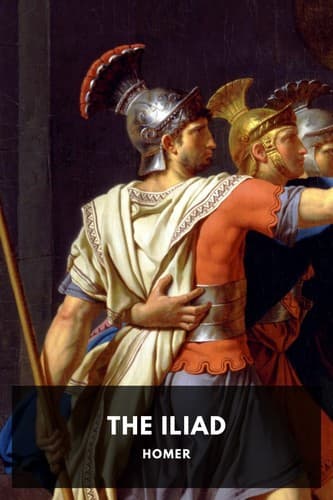
Achilles (Mythological character) -- Poetry; Classical literature; Epic poetry, Greek -- Translations into English; Trojan War -- Poetry
This pure and noble simplicity is nowhere in such perfection as in the
Scripture and our author. One may affirm, with all respect to the
inspired writings, that the Divine Spirit made use of no other words
but what were intelligible and common to men at that time, and in that
part of the world; and, as Homer is the author nearest to those, his
style must of course bear a greater resemblance to the sacred books
than that of any other writer. This consideration (together with what
has been observed of the parity of some of his thoughts) may, methinks,
induce a translator, on the one hand, to give in to several of those
general phrases and manners of expression, which have attained a
veneration even in our language from being used in the Old Testament;
as, on the other, to avoid those which have been appropriated to the
Divinity, and in a manner consigned to mystery and religion.
For a further preservation of this air of simplicity, a particular care
should be taken to express with all plainness those moral sentences and
proverbial speeches which are so numerous in this poet. They have
something venerable, and as I may say, oracular, in that unadorned
gravity and shortness with which they are delivered: a grace which
would be utterly lost by endeavouring to give them what we call a more
ingenious (that is, a more modern) turn in the paraphrase.
Perhaps the mixture of some Græcisms and old words after the manner of
Milton, if done without too much affectation, might not have an ill
effect in a version of this particular work, which most of any other
seems to require a venerable, antique cast. But certainly the use of
modern terms of war and government, such as “platoon, campaign, junto,”
or the like, (into which some of his translators have fallen) cannot be
allowable; those only excepted without which it is impossible to treat
the subjects in any living language.
There are two peculiarities in Homer’s diction, which are a sort of
marks or moles by which every common eye distinguishes him at first
sight; those who are not his greatest admirers look upon them as
defects, and those who are, seemed pleased with them as beauties. I
speak of his compound epithets, and of his repetitions. Many of the
former cannot be done literally into English without destroying the
purity of our language. I believe such should be retained as slide
easily of themselves into an English compound, without violence to the
ear or to the received rules of composition, as well as those which
have received a sanction from the authority of our best poets, and are
become familiar through their use of them; such as “the
cloud-compelling Jove,” &c. As for the rest, whenever any can be as
fully and significantly expressed in a single word as in a compounded
one, the course to be taken is obvious.
Public-domain text, read in full here on John Shaqi.
Reviews
Reviews
No reviews yet
Be the first to share your thoughts on this work.
Join the Discussion
Join the discussion
Sign in to leave a comment or review.
Sign InorCreate an account