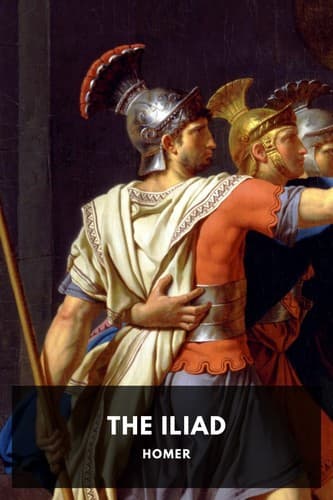
Achilles (Mythological character) -- Poetry; Classical literature; Epic poetry, Greek -- Translations into English; Trojan War -- Poetry
It only remains to speak of the versification. Homer (as has been said)
is perpetually applying the sound to the sense, and varying it on every
new subject. This is indeed one of the most exquisite beauties of
poetry, and attainable by very few: I only know of Homer eminent for it
in the Greek, and Virgil in the Latin. I am sensible it is what may
sometimes happen by chance, when a writer is warm, and fully possessed
of his image: however, it may reasonably be believed they designed
this, in whose verse it so manifestly appears in a superior degree to
all others. Few readers have the ear to be judges of it: but those who
have, will see I have endeavoured at this beauty.
Upon the whole, I must confess myself utterly incapable of doing
justice to Homer. I attempt him in no other hope but that which one may
entertain without much vanity, of giving a more tolerable copy of him
than any entire translation in verse has yet done. We have only those
of Chapman, Hobbes, and Ogilby. Chapman has taken the advantage of an
immeasurable length of verse, notwithstanding which, there is scarce
any paraphrase more loose and rambling than his. He has frequent
interpolations of four or six lines; and I remember one in the
thirteenth book of the Odyssey, ver. 312, where he has spun twenty
verses out of two. He is often mistaken in so bold a manner, that one
might think he deviated on purpose, if he did not in other places of
his notes insist so much upon verbal trifles. He appears to have had a
strong affectation of extracting new meanings out of his author;
insomuch as to promise, in his rhyming preface, a poem of the mysteries
he had revealed in Homer; and perhaps he endeavoured to strain the
obvious sense to this end. His expression is involved in fustian; a
fault for which he was remarkable in his original writings, as in the
tragedy of Bussy d’Amboise, &c. In a word, the nature of the man may
account for his whole performance; for he appears, from his preface and
remarks, to have been of an arrogant turn, and an enthusiast in poetry.
His own boast, of having finished half the Iliad in less than fifteen
weeks, shows with what negligence his version was performed. But that
which is to be allowed him, and which very much contributed to cover
his defects, is a daring fiery spirit that animates his translation,
which is something like what one might imagine Homer himself would have
writ before he arrived at years of discretion.
Public-domain text, read in full here on John Shaqi.
Reviews
Reviews
No reviews yet
Be the first to share your thoughts on this work.
Join the Discussion
Join the discussion
Sign in to leave a comment or review.
Sign InorCreate an account