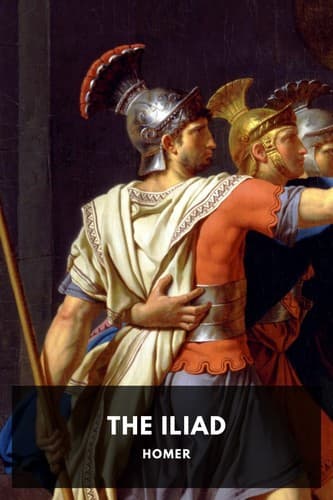
Achilles (Mythological character) -- Poetry; Classical literature; Epic poetry, Greek -- Translations into English; Trojan War -- Poetry
Before, however, entering into particulars respecting the question of
this unity of the Homeric poems, (at least of the Iliad,) I must
express my sympathy with the sentiments expressed in the following
remarks:—
“We cannot but think the universal admiration of its unity by the
better, the poetic age of Greece, almost conclusive testimony to its
original composition. It was not till the age of the grammarians that
its primitive integrity was called in question; nor is it injustice to
assert, that the minute and analytical spirit of a grammarian is not
the best qualification for the profound feeling, the comprehensive
conception of an harmonious whole. The most exquisite anatomist may be
no judge of the symmetry of the human frame: and we would take the
opinion of Chantrey or Westmacott on the proportions and general beauty
of a form, rather than that of Mr. Brodie or Sir Astley Cooper.
“There is some truth, though some malicious exaggeration, in the lines
of Pope.—
“‘The critic eye—that microscope of wit
Sees hairs and pores, examines bit by bit,
How parts relate to parts, or they to whole,
The body’s harmony, the beaming soul,
Are things which Kuster, Burmann, Wasse, shall see,
When man’s whole frame is obvious to a flea.’”[19]
Long was the time which elapsed before any one dreamt of questioning
the unity of the authorship of the Homeric poems. The grave and
cautious Thucydides quoted without hesitation the Hymn to Apollo,[20]
the authenticity of which has been already disclaimed by modern
critics. Longinus, in an oft quoted passage, merely expressed an
opinion touching the comparative inferiority of the Odyssey to the
Iliad,[21] and, among a mass of ancient authors, whose very names[22]
it would be tedious to detail, no suspicion of the personal
non-existence of Homer ever arose. So far, the voice of antiquity seems
to be in favour of our early ideas on the subject; let us now see what
are the discoveries to which more modern investigations lay claim.
At the end of the seventeenth century, doubts had begun to awaken on
the subject, and we find Bentley remarking that “Homer wrote a sequel
of songs and rhapsodies, to be sung by himself, for small comings and
good cheer, at festivals and other days of merriment. These loose songs
were not collected together, in the form of an epic poem, till about
Peisistratus’ time, about five hundred years after.”[23]
Two French writers—Hedelin and Perrault—avowed a similar scepticism on
the subject; but it is in the “Scienza Nuova” of Battista Vico, that we
first meet with the germ of the theory, subsequently defended by Wolf
with so much learning and acuteness. Indeed, it is with the Wolfian
theory that we have chiefly to deal, and with the following bold
hypothesis, which we will detail in the words of Grote:—[24]
Public-domain text, read in full here on John Shaqi.
Reviews
Reviews
No reviews yet
Be the first to share your thoughts on this work.
Join the Discussion
Join the discussion
Sign in to leave a comment or review.
Sign InorCreate an account