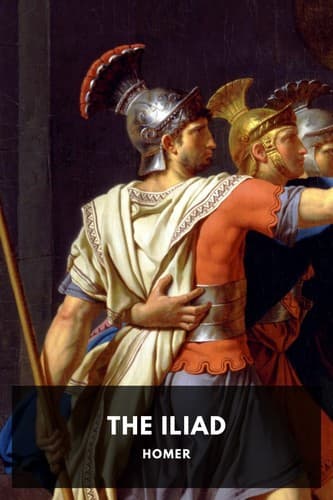
Achilles (Mythological character) -- Poetry; Classical literature; Epic poetry, Greek -- Translations into English; Trojan War -- Poetry
“Half a century ago, the acute and valuable Prolegomena of F. A. Wolf,
turning to account the Venetian Scholia, which had then been recently
published, first opened philosophical discussion as to the history of
the Homeric text. A considerable part of that dissertation (though by
no means the whole) is employed in vindicating the position, previously
announced by Bentley, amongst others, that the separate constituent
portions of the Iliad and Odyssey had not been cemented together into
any compact body and unchangeable order, until the days of
Peisistratus, in the sixth century before Christ. As a step towards
that conclusion, Wolf maintained that no written copies of either poem
could be shown to have existed during the earlier times, to which their
composition is referred; and that without writing, neither the perfect
symmetry of so complicated a work could have been originally conceived
by any poet, nor, if realized by him, transmitted with assurance to
posterity. The absence of easy and convenient writing, such as must be
indispensably supposed for long manuscripts, among the early Greeks,
was thus one of the points in Wolf’s case against the primitive
integrity of the Iliad and Odyssey. By Nitzsch, and other leading
opponents of Wolf, the connection of the one with the other seems to
have been accepted as he originally put it; and it has been considered
incumbent on those who defended the ancient aggregate character of the
Iliad and Odyssey, to maintain that they were written poems from the
beginning.
“To me it appears, that the architectonic functions ascribed by Wolf to
Peisistratus and his associates, in reference to the Homeric poems, are
nowise admissible. But much would undoubtedly be gained towards that
view of the question, if it could be shown, that, in order to
controvert it, we were driven to the necessity of admitting long
written poems, in the ninth century before the Christian æra. Few
things, in my opinion, can be more improbable; and Mr. Payne Knight,
opposed as he is to the Wolfian hypothesis, admits this no less than
Wolf himself. The traces of writing in Greece, even in the seventh
century before the Christian æra, are exceedingly trifling. We have no
remaining inscription earlier than the fortieth Olympiad, and the early
inscriptions are rude and unskilfully executed; nor can we even assure
ourselves whether Archilochus, Simonidês of Amorgus, Kallinus,
Tyrtæus, Xanthus, and the other early elegiac and lyric poets,
committed their compositions to writing, or at what time the practice
of doing so became familiar. The first positive ground which authorizes
us to presume the existence of a manuscript of Homer, is in the famous
ordinance of Solôn, with regard to the rhapsodies at the Panathenæa:
but for what length of time previously manuscripts had existed, we are
unable to say.
Public-domain text, read in full here on John Shaqi.
Reviews
Reviews
No reviews yet
Be the first to share your thoughts on this work.
Join the Discussion
Join the discussion
Sign in to leave a comment or review.
Sign InorCreate an account