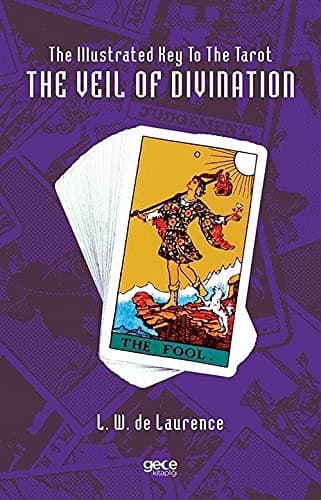
The Illustrated Key to the Tarot: The Veil of DivinationDe Laurence, L. W. (Lauron William)
Religion
The Illustrated Key to the Tarot: The Veil of Divination
De Laurence, L. W. (Lauron William)
Fortune-telling by cards; Tarot
20. The Last Judgment. I have spoken of this symbol already,
the form of which is essentially invariable, even in the Etteilla
set. An angel sounds his trumpet per sepulchra regionum,
and the dead arise. It matters little that Etteilla omits the angel,
or that Dr. Papus substitutes a ridiculous figure, which is, however,
in consonance with the general motive of that Tarot set
which accompanies his latest work. Before rejecting the transparent
interpretation of the symbolism which is conveyed by the
name of the card and by the picture which it presents to the
eye, we should feel very sure of our ground. On the surface, at
least, it is and can be only the resurrection of that triad—father,
mother, child—whom we have met with already in the eighth
card. M. Bourgeat hazards the suggestion that esoterically it is
the symbol of evolution—of which it carries none of the signs.
Others say that it signifies renewal, which is obvious enough;
that it is the triad of human life; that it is the "generative force
of the earth ... and eternal life." Court de Gebelin
makes himself impossible as usual, and points out that if the
grave-stones were removed it could be accepted as a symbol of
creation.
21—which, however, in most of the arrangements is the cipher
card, number nothing—The Fool, Mate, or Unwise Man. Court
de Gebelin places it at the head of the whole series as the zero or
negative which is pre-supposed by numeration, and as this is a
simpler so also it is a better arrangement. It has been abandoned
because in later times the cards have been attributed to the letters
of the Hebrew alphabet, and there has been apparently some
difficulty about allocating the zero symbol satisfactorily in a sequence
of letters all of which signify numbers. In the present
reference of the card to the letter Shin, which corresponds to 200,
the difficulty or the unreason remains. The truth is that the real
arrangement of the cards has never transpired. The Fool carries
a wallet; he is looking over his shoulder and does not know that
he is on the brink of a precipice; but a dog or other animal—some
call it a tiger—is attacking him from behind, and he is hurried to
his destruction unawares. Etteilla has given a justifiable variation
of this card—as generally understood—in the form of a court
jester, with cap, bells and motley garb. The other descriptions
say that the wallet contains the bearer's follies and vices, which
seems bourgeois and arbitrary.
Public-domain text, read in full here on John Shaqi.
Reviews
Reviews
No reviews yet
Be the first to share your thoughts on this work.
Join the Discussion
Join the discussion
Sign in to leave a comment or review.
Sign InorCreate an account