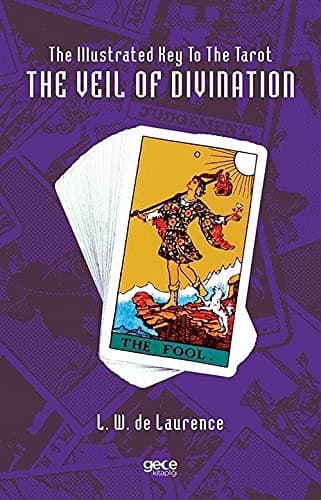
The Illustrated Key to the Tarot: The Veil of DivinationDe Laurence, L. W. (Lauron William)
Religion
The Illustrated Key to the Tarot: The Veil of Divination
De Laurence, L. W. (Lauron William)
Fortune-telling by cards; Tarot
16. The Tower struck by Lightning. Its alternative titles
are: Castle of Plutus, God's (Nature's) House and the Tower of
Babel. In the last case, the figures falling therefrom are held to
be Nimrod and his minister. It is assuredly a card of confusion,
and the design corresponds, broadly speaking, to any of the designations
except Maison Dieu, unless we are to understand that
the House of God (Nature) has been abandoned and the veil of
the temple rent. It is a little surprising that the device has not
so far been allocated to the destruction of Solomon's Temple,
when the lightning would symbolize the fire and sword with
which that edifice was visited by the King of the Chaldees.
17. The Star, Dog-Star, or Sirius, also called fantastically
the Star of the Magi. Grouped about it are seven minor luminaries,
and beneath it is a naked female figure, with her left knee
upon the earth and her right foot upon the water. She is in the
act of pouring fluids from two vessels. A bird is perched on a
tree near her; for this a butterfly on a rose has been substituted in
some later cards. So also the Star has been called that of Hope.
This is one of the cards which Court de Gebelin describes as
wholly Egyptian—that is to say, in his own reverie.
18. The Moon. Some eighteenth-century cards show the
luminary on its waning side; in the debased edition of Etteilla, it
is the moon at night in her plenitude, set in a heaven of stars;
of recent years the moon is shown on the side of her increase. In
nearly all presentations she is shining brightly and shedding the
moisture of fertilizing dew in great drops. Beneath there are two
towers, between which a path winds to the verge of the horizon.
Two dogs, or alternatively a wolf and dog, are baying at the
moon, and in the foreground there is water, through which a
crayfish moves towards the land.
19. The Sun. The luminary is distinguished in older cards
by chief rays that are waved and salient alternately and by secondary
salient rays. It appears to shed its influence on earth not
only by light and heat, but—like the moon—by drops of dew.
Court de Gebelin termed these tears of gold and of pearl just as
he identified the lunar dew with the tears of Isis. Beneath the
dog-star there is a wall suggesting an enclosure—as it might be,
a walled garden—wherein are two children, either naked or
lightly clothed, facing a water, and gambolling, or running hand
in hand. Eliphas Lévi says that these are sometimes replaced by
a spinner unwinding destinies, and otherwise by a much better
symbol—a naked child mounted on a white horse and displaying
a scarlet standard.
Public-domain text, read in full here on John Shaqi.
Reviews
Reviews
No reviews yet
Be the first to share your thoughts on this work.
Join the Discussion
Join the discussion
Sign in to leave a comment or review.
Sign InorCreate an account