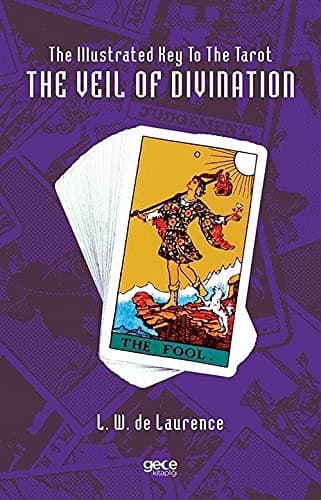
The Illustrated Key to the Tarot: The Veil of DivinationDe Laurence, L. W. (Lauron William)
Religion
The Illustrated Key to the Tarot: The Veil of Divination
De Laurence, L. W. (Lauron William)
Fortune-telling by cards; Tarot
The resources of interpretation have been lavished, if not
exhausted, on the twenty-two Trumps Major, the symbolism of
which is unquestionable. There remain the four suits, being
Wands or Scepters—ex hypothesi, in the archæology of the subject,
the antecedents of Diamonds in modern cards: Cups, corresponding
to Hearts; Swords, which answer to Clubs, as the
weapon of chivalry is in relation to the peasant's quarter-staff
or the Alsatian bludgeon; and, finally, Pentacles—called also
Deniers and Money—which are the prototypes of Spades. In
the old as in the new suits, there are ten numbered cards, but in
the Tarot there are four Court Cards allocated to each suit, or
a Knight in addition to King, Queen and Knave. The Knave is
a page, valet, or damoiseau; most correctly, he is an esquire,
presumably in the service of the Knight; but there are certain
rare sets in which the page becomes a maid of honor, thus pairing
the sexes in the tetrad of the court cards. There are naturally
distinctive features in respect of the several pictures, by which
I mean that the King of Wands is not exactly the same personage
as the King of Cups, even after allowance has been
made for the different emblems that they bear; but the symbolism
resides in their rank and in the suit to which they belong.
So also the smaller cards, which—until now—have never been
issued pictorially in these our modern days, depend on the particular
meaning attaching to their numbers in connection with
the particular suit. I reserve, therefore, the details of the Lesser
Arcana, till I come to speak in the second part of the rectified
and perfected Tarot which accompanies this work. The consensus
of divinatory meanings attached both to the greater and
lesser symbols belongs to the third part.
Section 4
THE TAROT IN HISTORY
Our immediate next concern is to speak of the cards in their
history, so that the speculations and reveries, which have been
perpetuated and multiplied in the schools of occult research may
be disposed of once and for all, as intimated in the preface hereto.
Let it be understood at the beginning of this point that there
are several sets or sequences of ancient cards which are only in
part of our concern. The Tarot Of The Bohemians, by Papus,
which I have recently carried through the press, revising the
imperfect rendering, has some useful information in this connection,
and, except for the omission of dates and other evidences
of the archæological sense, it will serve the purpose of the general
reader. I do not propose to extend it in the present place
in any manner that can be called considerable, but certain additions
are desirable and so also is a distinct mode of presentation.
Public-domain text, read in full here on John Shaqi.
Reviews
Reviews
No reviews yet
Be the first to share your thoughts on this work.
Join the Discussion
Join the discussion
Sign in to leave a comment or review.
Sign InorCreate an account