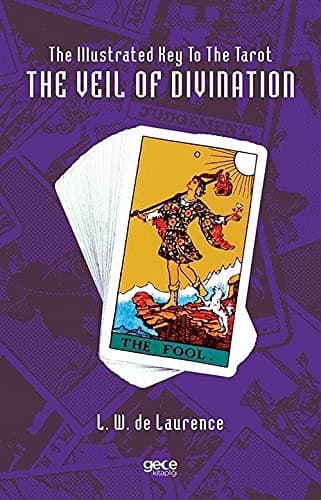
The Illustrated Key to the Tarot: The Veil of Divination — John Shaqi
The Illustrated Key to the Tarot: The Veil of DivinationDe Laurence, L. W. (Lauron William)
Religion
The Illustrated Key to the Tarot: The Veil of Divination
De Laurence, L. W. (Lauron William)
Fortune-telling by cards; Tarot
(1) The figures and arrangement of the game are manifestly
allegorical; (2) the allegories are in conformity with the civil,
philosophical and religious doctrine of ancient Egypt; (3) if the
cards were modern, no High Priestess would be included among
the Greater Arcana; (4) the figure in question bears the horns of
Isis; (5) the card which is called the Emperor has a scepter terminating
in a triple cross; (6) the card entitled the Moon, who
is Isis, shows drops of rain or dew in the act of being shed by
the luminary and these—as we have seen—are the tears of Isis,
which swelled the waters of the Nile and fertilized the fields of
Egypt; (7) the seventeenth card, or Star, is the dog-star, Sirius
which was consecrated to Isis and symbolized the opening of the
year; (8) the game played with the Tarot is founded on the
sacred number seven, which was of great importance in Egypt;
(9) the word Tarot is pure Egyptian, in which language
Tar = way or road, and Ro = king or royal—it signifies therefore
the Royal Road of Life; (10) alternatively, it is derived
from A = doctrine; Rosh = Mercury = Thoth, and the article
T; in sum, Tarosh; and therefore the Tarot is the Book Of
Thoth, or the Table Of The Doctrine Of Mercury.
Such is the testimony, it being understood that I have set aside
several casual statements, for which no kind of justification is
produced. These, therefore, are ten pillars which support the
edifice of the thesis, and the same are pillars of sand. The Tarot
is, of course, allegorical—that is to say, it is symbolism—but allegory
and symbol are catholic—of all countries, nations and times;
they are not more Egyptian than Mexican; they are of Europe
and Cathay, of Tibet beyond the Himalayas and of the London
gutters. As allegory and symbol, the cards correspond to many
types of ideas and things; they are universal and not particular;
and the fact that they do not especially and peculiarly respond to
Egyptian doctrine—religious, philosophical or civil—is clear from
the failure of Court de Gebelin to go further than the affirmation.
The presence of a High Priestess among the Trumps
Major is more easily explained as the memorial of some popular
superstition—that worship of Diana, for example, the persistence
of which in modern Italy has been traced with such striking
results by Leland. We have also to remember the universality
of horns in every cultus, not excepting that of Tibet. The triple
cross is preposterous as an instance of Egyptian symbolism; it is
the cross of the patriarchal see, both Greek and Latin—of Venice,
of Jerusalem, for example—and it is the form of signing used to
this day by the priests and laity of the Orthodox Rite. I pass
over the idle allusion to the tears of Isis, because other occult
writers have told us that they are Hebrew Jods; as regards the
seventeenth card, it is the star Sirius or another, as predisposition
pleases; the number seven was certainly important in Egypt and
Public-domain text, read in full here on John Shaqi.
Reviews
Reviews
No reviews yet
Be the first to share your thoughts on this work.
Join the Discussion
Join the discussion
Sign in to leave a comment or review.
Sign InorCreate an account