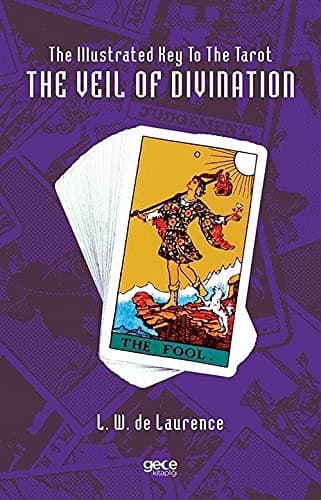
The Illustrated Key to the Tarot: The Veil of Divination — John Shaqi
The Illustrated Key to the Tarot: The Veil of DivinationDe Laurence, L. W. (Lauron William)
Religion
The Illustrated Key to the Tarot: The Veil of Divination
De Laurence, L. W. (Lauron William)
Fortune-telling by cards; Tarot
So far as regards what is indispensable as preliminaries to the
historical aspects of Tarot cards, and I will now take up the
speculative side of the subject and produce its test of value. In
my preface to The Tarot Of The Bohemians I have mentioned
that the first writer who made known the fact of the cards was
the archæologist Court de Gebelin, who, just prior to the French
Revolution, occupied several years in the publication of his
Monde Primitif, which extended to nine quarto volumes. He
was a learned man of his epoch, a high-grade Mason, a member
of the historical Lodge of the Philalethes, and a virtuoso with a
profound and lifelong interest in the debate on universal antiquities
before a science of the subject existed. Even at this day, his
memorials and dissertations, collected under the title which I
have quoted, are worth possessing. By an accident of things, he
became acquainted with the Tarot when it was quite unknown in
Paris, and at once conceived that it was the remnants of an
Egyptian book. He made inquiries concerning it and ascertained
that it was in circulation over a considerable part of Europe—Spain,
Italy, Germany and the South of France. It was in use
as a game of chance or skill, after the ordinary manner of
playing-cards; and he ascertained further how the game was
played. But it was in use also for the higher purpose of divination
or fortune-telling, and with the help of a learned friend he
discovered the significance attributed to the cards, together with
the method of arrangement adopted for this purpose. In a
word, he made a distinct contribution to our knowledge, and he
is still a source of reference—but it is on the question of fact only,
and not on the beloved hypothesis that the Tarot contains pure
Egyptian doctrine. However, he set the opinion which is prevalent
to this day throughout the occult schools that in the mystery
and wonder, the strange night of the gods, the unknown tongue
and the undeciphered hieroglyphics which symbolized Egypt at
the end of the eighteenth century, the origin of the cards was lost.
So dreamed one of the characteristic literati of France, and one
can almost understand and sympathize, for the country about the
Delta and the Nile was beginning to loom largely in the preoccupation
of learned thought, and omne ignotum pro Ægyptiaco was
the way the delusion to which many minds tended. It was
excusable enough then, but that the madness was continued and,
within the charmed circle of the occult sciences, still passes from
mouth to mouth—there is no excuse for this. Let us see, therefore,
the evidence produced by M. Court de Gebelin in support of
his thesis, and, that I may deal justly, it shall be summarized as
far as possible in his own words.
Public-domain text, read in full here on John Shaqi.
Reviews
Reviews
No reviews yet
Be the first to share your thoughts on this work.
Join the Discussion
Join the discussion
Sign in to leave a comment or review.
Sign InorCreate an account