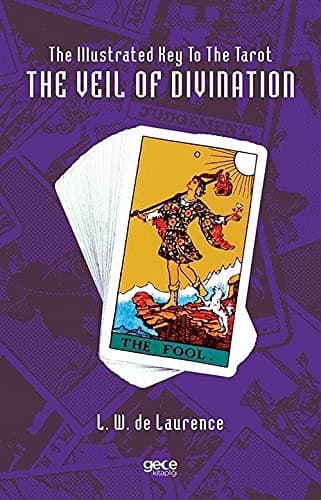
The Illustrated Key to the Tarot: The Veil of Divination — John Shaqi
The Illustrated Key to the Tarot: The Veil of DivinationDe Laurence, L. W. (Lauron William)
Religion
The Illustrated Key to the Tarot: The Veil of Divination
De Laurence, L. W. (Lauron William)
Fortune-telling by cards; Tarot
The long and heterogeneous story of Le Monde Primitif had
come to the end of its telling in 1782, and in 1783 the tracts of
Etteilla had begun pouring from the press, testifying that already
he had spent thirty, nay, almost forty years in the study of Egyptian
magic, and that he had found the final keys. They were, in
fact, the Keys of the Tarot, which was a book of philosophy and
the Book Of Thoth, but at the same time it was actually written
by seventeen Magi in a Temple of Fire, on the borders of the
Levant, some three leagues from Memphis. It contained the
science of the universe, and the cartomancist proceeded to apply
it to Astrology, Alchemy, and fortune-telling, without the slightest
diffidence or reserve as to the fact that he was driving a trade.
I have really little doubt that he considered it genuine as a métier,
and that he himself was the first person whom he convinced concerning
his system. But the point which we have to notice is that
in this manner was the antiquity of the Tarot generally trumpeted
forth. The little books of Etteilla are proof positive that he did
not know even his own language; when in the course of time he
produced a reformed Tarot, even those who think of him tenderly
admit that he spoiled its symbolism; and in respect of antiquities
he had only Court de Gebelin as his universal authority.
The cartomancists succeeded one another in the manner which
I have mentioned, and of course there were rival adepts of these
less than least mysteries; but the scholarship of the subject, if it
can be said to have come into existence, reposed after all in the
quarto of Court de Gebelin for something more than sixty years.
On his authority, there is very little doubt that every one who
became acquainted, by theory or practice, by casual or special
concern, with the question of Tarot cards, accepted their Egyptian
character. It is said that people are taken commonly at their
own valuation, and—following as it does the line of least resistance—the
unsolicitous general mind assuredly accepts archæological
pretensions in the sense of their own daring and of those
who put them forward. The first who appeared to reconsider the
subject with some presumptive titles to a hearing was the French
writer Duchesne, but I am compelled to pass him over with a
mere reference, and so also some interesting researches on the
general subject of playing-cards by Singer in England. The latter
believed that the old Venetian game called Trappola was the
earliest European form of card-playing, that it was of Arabian
origin, and that the fifty-two cards used for the purpose derived
from that region. I do not gather that any importance was ever
attached to this view.
Public-domain text, read in full here on John Shaqi.
Reviews
Reviews
No reviews yet
Be the first to share your thoughts on this work.
Join the Discussion
Join the discussion
Sign in to leave a comment or review.
Sign InorCreate an account