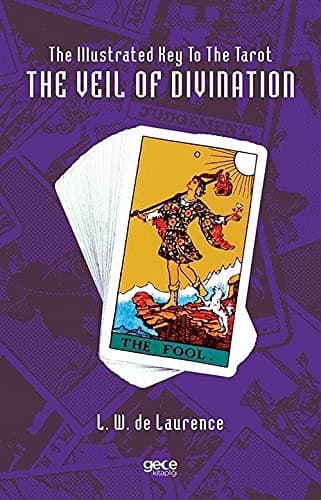
The Illustrated Key to the Tarot: The Veil of DivinationDe Laurence, L. W. (Lauron William)
Religion
The Illustrated Key to the Tarot: The Veil of Divination
De Laurence, L. W. (Lauron William)
Fortune-telling by cards; Tarot
Duchesne and Singer were followed by another English writer,
W. A. Chatto, who reviewed the available facts and the cloud of
speculations which had already arisen on the subject. This was
in 1848, and his work has still a kind of standard authority, but—after
every allowance for a certain righteousness attributable to
the independent mind—it remains an indifferent and even a poor
performance. It was, however, characteristic in its way of the
approaching middle night of the nineteenth century. Chatto
rejected the Egyptian hypothesis, but as he was at very little pains
concerning it, he would scarcely be held to displace Court de
Gebelin if the latter had any firm ground beneath his hypothesis.
In 1854 another French writer, Boiteau, took up the general
question, maintaining the oriental origin of Tarot cards, though
without attempting to prove it. I am not certain, but I think that
he is the first writer who definitely identified them with the
Gipsies; for him, however, the original Gipsy home was in India,
and Egypt did not therefore enter into his calculation.
In 1860 there arose Eliphas Lévi, a brilliant and profound
illuminé whom it is impossible to accept, and with whom it is
even more impossible to dispense. There was never a mouth
declaring such great things, of all the western voices which have
proclaimed or interpreted the science called occult and the doctrine
called magical. I suppose that, fundamentally speaking, he
cared as much and as little as I do for the phenomenal part, but
he explained the phenomena with the assurance of one who
openly regarded charlatanry as a great means to an end, if used
in a right cause. He came unto his own and his own received
him, also at his proper valuation, as a man of great learning—which
he never was—and as a revealer of all mysteries without
having been received into any. I do not think that there was ever
an instance of a writer with greater gifts, after their particular
kind, who put them to such indifferent uses. After all, he was
only Etteilla a second time in the flesh, endowed in his transmutation
with a mouth of gold and a wider casual knowledge. This
notwithstanding, he has written the most comprehensive, brilliant,
enchanting History Of Magic which has ever been drawn
into writing in any language. The Tarot and the de Gebelin
hypothesis he took into his heart of hearts, and all occult France
and all esoteric Britain, Martinists, half-instructed Kabalists,
schools of soi disant theosophy—there, here and everywhere—have
accepted his judgment about it with the same confidence as
his interpretations of those great classics of Kabalism which he
had skimmed rather than read. The Tarot for him was not only
the most perfect instrument of divination and the keystone of
occult science, but it was the primitive book, the sole book of the
ancient Magi, the miraculous volume which inspired all the sacred
writings of antiquity. In his first work Lévi was content, however,
Public-domain text, read in full here on John Shaqi.
Reviews
Reviews
No reviews yet
Be the first to share your thoughts on this work.
Join the Discussion
Join the discussion
Sign in to leave a comment or review.
Sign InorCreate an account