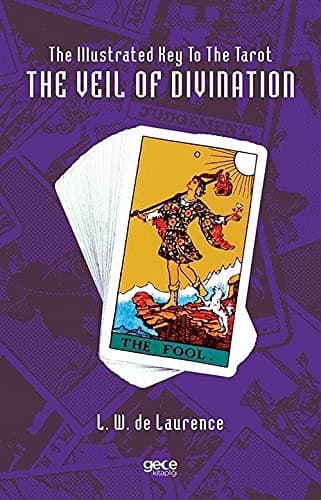
The Illustrated Key to the Tarot: The Veil of Divination — John Shaqi
The Illustrated Key to the Tarot: The Veil of DivinationDe Laurence, L. W. (Lauron William)
Religion
The Illustrated Key to the Tarot: The Veil of Divination
De Laurence, L. W. (Lauron William)
Fortune-telling by cards; Tarot
with accepting the construction of Court de Gebelin and
reproducing the seventh Trump Major with a few Egyptian
characteristics. The question of Tarot transmission through the
Gipsies did not occupy him, till J. A. Vaillant, a bizarre writer
with great knowledge of the Romany people, suggested it in his
work on those wandering tribes. The two authors were almost
coincident and reflected one another thereafter. It remained for
Romain Merlin, in 1869, to point out what should have been
obvious, namely, that cards of some kind were known in Europe
prior to the arrival of the Gipsies in or about 1417. But as this was
their arrival at Lüneburg, and as their presence can be traced
antecedently, the correction loses a considerable part of its force;
it is safer, therefore, to say that the evidence for the use of the
Tarot by Romany tribes was not suggested till after the year
1840; the fact that some Gipsies before this period were found
using cards is quite explicable on the hypothesis not that they
brought them into Europe but found them there already and
added them to their stock in trade.
We have now seen that there is no particle of evidence for the
Egyptian origin of Tarot cards. Looking in other directions, it
was once advanced on native authority that cards of some kind
were invented in China about the year A. D. 1120. Court de
Gebelin believed in his zeal that he had traced them to a Chinese
inscription of great imputed antiquity which was said to refer to
the subsidence of the waters of the Deluge. The characters of
this inscription were contained in seventy-seven compartments,
and this constitutes the analogy. India had also its tablets,
whether cards or otherwise, and these have suggested similar
slender similitudes. But the existence, for example, of ten suits
or styles, of twelve numbers each, and representing the avatars of
Vishnu, as a fish, tortoise, boar, lion, monkey, hatchet, umbrella,
or bow, as a goat, a boodh and as a horse in fine,
are not going to help us towards the origin of our own
Trumps Major, nor do crowns and harps—nor even the presence
of possible coins as a synonym of deniers and perhaps as an
equivalent of pentacles—do much to elucidate the Lesser Arcana.
If every tongue and people and clime and period possessed their
cards—if with these also they philosophized, divined and
gambled—the fact would be interesting enough, but unless they
were Tarot cards, they would illustrate only the universal tendency
of man to be pursuing the same things in more or less the
same way.
Public-domain text, read in full here on John Shaqi.
Reviews
Reviews
No reviews yet
Be the first to share your thoughts on this work.
Join the Discussion
Join the discussion
Sign in to leave a comment or review.
Sign InorCreate an account