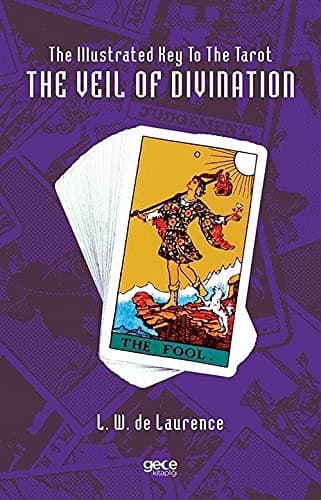
The Illustrated Key to the Tarot: The Veil of DivinationDe Laurence, L. W. (Lauron William)
Religion
The Illustrated Key to the Tarot: The Veil of Divination
De Laurence, L. W. (Lauron William)
Fortune-telling by cards; Tarot
A stately figure, seated, having rich vestments and royal aspect,
as of a daughter of heaven and earth. Her diadem is of twelve
stars, gathered in a cluster. The symbol of Venus is on the
shield which rests near her. A field of corn is ripening in front
of her, and beyond there is a fall of water. The scepter which
she bears is surmounted by the globe of this world. She is the
inferior Garden of Eden, the Earthly Paradise, all that is symbolized
by the visible house of man. She is not Regina coeli, but
she is still refugium peccatorum, the fruitful mother of thousands.
There are also certain aspects in which she has been correctly
described as desire and the wings thereof, as the woman
clothed with the sun, as Gloria Mundi and the veil of the Sanctum
Sanctorum; but she is not, I may add, the soul that has
attained wings, unless all the symbolism is counted up another
and unusual way. She is above all things universal fecundity
and the outer sense of the Word. This is obvious, because there
is no direct message which has been given to man like that which
is borne by woman; but she does not herself carry its interpretation.
In another order of ideas, the card of the Empress signifies the
door or gate by which an entrance is obtained into this life, as
into the Garden of Venus; and then the way which leads out
therefrom, into that which is beyond, is the secret known to the
High Priestess: it is communicated by her to the elect. Most old
attributions of this card are completely wrong on the symbolism—as,
for example, its identification with the Word, Divine Nature,
the Triad, and so forth.
FOUR. THE EMPEROR
He has a form of the Crux ansata for his scepter and a globe in
his left hand. He is crowned monarch—commanding, stately,
seated on a throne, the arms of which are fronted by rams' heads.
He is executive and realization, the power of this world, here
clothed with the highest of its natural attributes. He is occasionally
represented as seated on a cubic stone, which, however,
confuses some of the issues. He is the virile power, to which
the Empress responds, and in this sense is he who seeks to
remove the Veil of Isis; yet she remains virgo intacta.
Public-domain text, read in full here on John Shaqi.
Reviews
Reviews
No reviews yet
Be the first to share your thoughts on this work.
Join the Discussion
Join the discussion
Sign in to leave a comment or review.
Sign InorCreate an account