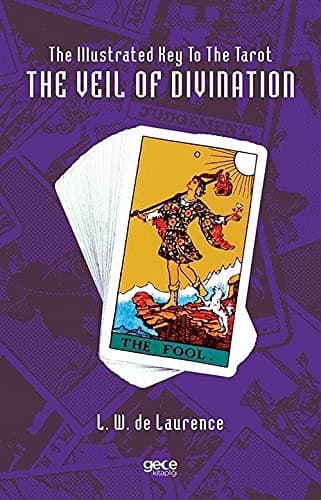
The Illustrated Key to the Tarot: The Veil of DivinationDe Laurence, L. W. (Lauron William)
Religion
The Illustrated Key to the Tarot: The Veil of Divination
De Laurence, L. W. (Lauron William)
Fortune-telling by cards; Tarot
It should be understood that this card and that of the Empress
do not precisely represent the condition of married life, though
this state is implied. On the surface, as I have indicated, they
stand for mundane royalty, uplifted on the seats of the mighty;
but above this there is the suggestion of another presence. They
signify, also—and the male figure especially—the higher kingship,
occupying the intellectual throne. Hereof is the lordship of
thought rather than of the animal world. Both personalities,
after their own manner, are "full of strange experience," but
theirs is not consciously the wisdom which draws from a higher
world. The Emperor has been described as (a) will in its
embodied form, but this is only one of its applications, and (b)
as an expression of virtualities contained in the Absolute Being—but
this is fantasy.
FIVE. THE HIEROPHANT
He wears the triple crown and is seated between two pillars,
but they are not those of the Temple which is guarded by the
High Priestess. In his left hand he holds a scepter terminating
in the triple cross, and with his right hand he gives the well-known
ecclesiastical sign which is called that of esotericism, distinguishing
between the manifest and concealed part of doctrine.
It is noticeable in this connection that the High Priestess makes
no sign. At his feet are the crossed keys, and two priestly ministers
in albs kneel before him. He has been usually called the
Pope, which is a particular application of the more general office
that he symbolizes. He is the ruling power of external religion,
as the High Priestess is the prevailing genius of the esoteric,
withdrawn power. The proper meanings of this card have suffered
woeful admixture from nearly all hands. Grand Orient
says truly that the Hierophant is the power of the keys, exoteric
orthodox doctrine, and the outer side of the life which leads to
the doctrine; but he is certainly not the prince of occult doctrine,
as another commentator has suggested.
He is rather the summa totius theologiæ, when it has passed
into the utmost rigidity of expression; but he symbolizes also all
things that are righteous and sacred on the manifest side. As
such, he is the channel of grace belonging to the world of institution
as distinct from that of Nature, and he is the leader of
salvation for the human race at large. He is the order and the
head of the recognized hierarchy, which is the reflection of
another and greater hierarchic order; but it may so happen that
the pontiff forgets the significance of this his symbolic state and
acts as if he contained within his proper measures all that his sign
signifies or his symbol seeks to show forth. He is not, as it has
been thought, philosophy—except on the theological side; he is
not inspiration; and he is not religion, although he is a mode of
its expression.
SIX. THE LOVERS
Public-domain text, read in full here on John Shaqi.
Reviews
Reviews
No reviews yet
Be the first to share your thoughts on this work.
Join the Discussion
Join the discussion
Sign in to leave a comment or review.
Sign InorCreate an account