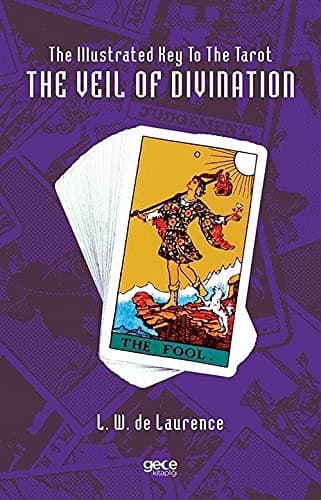
The Illustrated Key to the Tarot: The Veil of DivinationDe Laurence, L. W. (Lauron William)
Religion
The Illustrated Key to the Tarot: The Veil of Divination
De Laurence, L. W. (Lauron William)
Fortune-telling by cards; Tarot
A woman, over whose head there broods the same symbol of
life which we have seen in the card of the Hierophant, is closing
the jaws of a lion. The only point in which this design differs
from the conventional presentations is that her beneficent fortitude
has already subdued the lion, which is being led by a chain of
flowers. For reasons which satisfy myself, this card has been
interchanged with that of Justice, which is usually numbered
eight. As the variation carries nothing with it which will signify
to the reader, there is no cause for explanation. Fortitude, in
one of its most exalted aspects, is connected with the Divine
Mystery of Union; the virtue, of course, operates in all planes,
and hence draws on all in its symbolism. It connects also with
innocentia inviolata, and with the strength which resides in contemplation.
These higher meanings are, however, matters of inference, and
I do not suggest that they are transparent on the surface of the
card. They are intimated in a concealed manner by the chain of
flowers, which signifies, among many other things, the sweet yoke
and the light burden of Divine Law, when it has been taken into
the heart of hearts. The card has nothing to do with self-confidence
in the ordinary sense, though this has been suggested—but
it concerns the confidence of those whose strength is God
(Nature), who have found their refuge in Him. There is one
aspect in which the lion signifies the passions, and she who is
called Strength is the higher nature in its liberation. It has
walked upon the asp and the basilisk and has trodden down the
lion and the dragon.
NINE. THE HERMIT
The variation from the conventional models in this card is only
that the lamp is not enveloped partially in the mantle of its
bearer, who blends the idea of the Ancient of Days with the Light
of the World. It is a star which shines in the lantern. I have
said that this is a card of attainment, and to extend this conception
the figure is seen holding up his beacon on an eminence.
Therefore the Hermit is not, as Court de Gebelin explained, a
wise man in search of truth and justice; nor is he, as a later
explanation proposes, an especial example of experience. His
beacon intimates that "where I am, you also may be."
Public-domain text, read in full here on John Shaqi.
Reviews
Reviews
No reviews yet
Be the first to share your thoughts on this work.
Join the Discussion
Join the discussion
Sign in to leave a comment or review.
Sign InorCreate an account