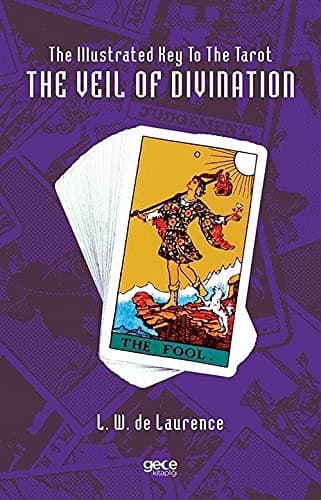
The Illustrated Key to the Tarot: The Veil of Divination — John Shaqi
The Illustrated Key to the Tarot: The Veil of DivinationDe Laurence, L. W. (Lauron William)
Religion
The Illustrated Key to the Tarot: The Veil of Divination
De Laurence, L. W. (Lauron William)
Fortune-telling by cards; Tarot
It is further a card which is understood quite incorrectly when
it is connected with the idea of occult isolation, as the protection
of personal magnetism against admixture. This is one of the
frivolous renderings which we owe to Eliphas Lévi. It has been
adopted by the French Order of Martinism and some of us have
heard a great deal of the Silent and Unknown Philosophy
enveloped by his mantle from the knowledge of the profane. In
true Martinism, the significance of the term Philosophe inconnu
was of another order. It did not refer to the intended concealment
of the Instituted Mysteries, much less of their substitutes,
but—like the card itself—to the truth that the Divine Mysteries
secure their own protection from those who are unprepared.
TEN. WHEEL OF FORTUNE
In this symbol I have again followed the reconstruction of
Eliphas Lévi, who has furnished several variants. It is legitimate—as
I have intimated—to use Egyptian symbolism when this
serves our purpose, provided that no theory of origin is implied
therein. I have, however, presented Typhon in his serpent form.
The symbolism is, of course, not exclusively Egyptian, as the four
Living Creatures of Ezekiel occupy the angles of the card, and
the wheel itself follows other indications of Lévi in respect
of Ezekiel's vision, as illustrative of the particular Tarot
Key. With the French occultist, and in the design itself,
the symbolic picture stands for the perpetual motion of a
fluidic universe and for the flux of human life. The Sphinx is
the equilibrium therein. The transliteration of Taro as Rota is
inscribed on the wheel, counterchanged with the letters of the
Divine Name—to show that Providence is implied through all.
But this is the Divine intention within, and the similar intention
without is exemplified by the four Living Creatures. Sometimes
the sphinx is represented couchant on a pedestal above, which
defrauds the symbolism by stultifying the essential idea of stability
amidst movement.
Behind the general notion expressed in the symbol there lies
the denial of chance and the fatality which is implied therein.
It may be added that, from the days of Lévi onward, the occult
explanations of this card are—even for occultism itself—of a
singularly fatuous kind. It has been said to mean principle,
fecundity, virile honor, ruling authority, etc. The findings of
common fortune-telling are better than this on their own plane.
ELEVEN. JUSTICE
As this card follows the traditional symbolism and carries
above all its obvious meanings, there is little to say regarding it
outside the few considerations collected in the first part, to which
the reader is referred.
Public-domain text, read in full here on John Shaqi.
Reviews
Reviews
No reviews yet
Be the first to share your thoughts on this work.
Join the Discussion
Join the discussion
Sign in to leave a comment or review.
Sign InorCreate an account