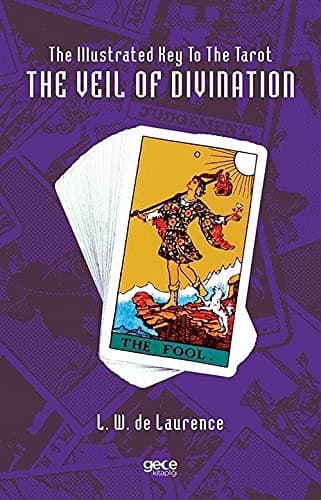
The Illustrated Key to the Tarot: The Veil of DivinationDe Laurence, L. W. (Lauron William)
Religion
The Illustrated Key to the Tarot: The Veil of Divination
De Laurence, L. W. (Lauron William)
Fortune-telling by cards; Tarot
We shall see in due course that the history of Tarot cards is
largely of the negative kind, and that, when the issues are cleared
by the dissipation of reveries and gratuitous speculations expressed
in the terms of certitude, there is in fact no history prior
to the fourteenth century. The deception and self-deception regarding
their origin in Egypt, India or China put a lying spirit
into the mouths of the first expositors, and the later occult writers
have done little more than reproduce the first false testimony in
the good faith of an intelligence unawakened to the issues of research.
As it so happens, all expositions have worked within a
very narrow range, and owe, comparatively speaking, little to the
inventive faculty. One brilliant opportunity has at least been
missed, for it has not so far occurred to any one that the Tarot
might perhaps have done duty and even originated as a secret
symbolical language of the Albigensian sects. I commend this
suggestion to the lineal descendants in the spirit of Gabriele Rossetti
and Eugène Aroux, to Mr. Harold Bayley as another New
Light On The Renaissance, and as a taper at least in the darkness
which, with great respect, might be serviceable to the zealous and
all-searching mind of Mrs. Cooper-Oakley. Think only what the
supposed testimony of watermarks on paper might gain from the
Tarot Card of the Pope or Hierophant, in connection with the
notion of a secret Albigensian patriarch, of which Mr. Bayley has
found in these same watermarks so much material to his purpose.
Think only for a moment about the card of the High Priestess as
representing the Albigensian church itself; and think of the
Tower struck by Lightning as typifying the desired destruction of
Papal Rome, the city on the seven hills, with the pontiff and his
temporal power cast down from the spiritual edifice when it is
riven by the wrath of God (Nature). The possibilities are so
numerous and persuasive that they almost deceive in their expression
one of the elect who has invented them. But there is more
even than this, though I scarcely dare to cite it. When the time
came for the Tarot cards to be the subject of their first formal
explanation, the archæologist Court de Gebelin reproduced some
of their most important emblems, and—if I may so term it—the
codex which he used has served—by means of his engraved plates—as
a basis of reference for many sets that have been issued subsequently.
The figures are very primitive and differ as such from
the cards of Etteilla, the Marseilles Tarot, and others still current
in France. I am not a good judge in such matters, but the fact
that every one of the Trumps Major might have answered for
watermark purposes is shown by the cases which I have quoted
and by one most remarkable example of the Ace of Cups.
Public-domain text, read in full here on John Shaqi.
Reviews
Reviews
No reviews yet
Be the first to share your thoughts on this work.
Join the Discussion
Join the discussion
Sign in to leave a comment or review.
Sign InorCreate an account