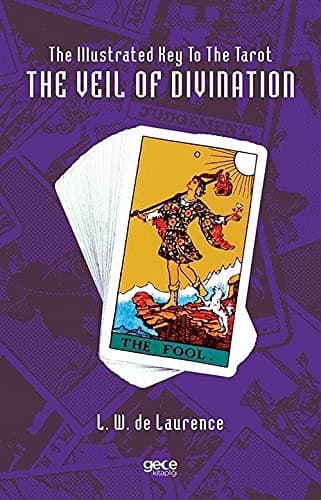
The Illustrated Key to the Tarot: The Veil of DivinationDe Laurence, L. W. (Lauron William)
Religion
The Illustrated Key to the Tarot: The Veil of Divination
De Laurence, L. W. (Lauron William)
Fortune-telling by cards; Tarot
I should call it an eucharistic emblem after the manner of a
ciborium, but this does not signify at the moment. The point is
that Mr. Harold Bayley gives six analogous devices in his New
Light On The Renaissance, being watermarks on paper of the
seventeenth century, which he claims to be of Albigensian origin
and to represent sacramental and Graal emblems. Had he only
heard of the Tarot, had he known that these cards of divination,
cards of fortune, cards of all vagrant arts, were perhaps current
at the period in the South of France, I think that his enchanting
but all too fantastic hypothesis might have dilated still more
largely in the atmosphere of his dream. We should no doubt
have had a vision of Christian Gnosticism, Manichæanism, and all
that he understands by pure primitive Gospel, shining behind the
pictures.
I do not look through such glasses, and I can only commend the
subject to his attention at a later period; it is mentioned here that
I may introduce with an unheard-of wonder the marvels of arbitrary
speculation as to the history of the cards.
With reference to their form and number, it should scarcely be
necessary to enumerate them, for they must be almost commonly
familiar, but as it is precarious to assume anything, and as there
are also other reasons, I will tabulate them briefly as follows:—
CLASS I
Section 2
TRUMPS MAJOR
OTHERWISE, GREATER ARCANA
1. The Magus, Magician, or Juggler, the caster of the dice
and mountebank, in the world of vulgar trickery. This is the
colportage interpretation, and it has the same correspondence
with the real symbolical meaning that the use of the Tarot in
fortune-telling has with its mystic construction according to the
secret science of symbolism. I should add that many independent
students of the subject, following their own lights, have
produced individual sequences of meaning in respect of the
Trumps Major, and their lights are sometimes suggestive, but
they are not the true lights. For example, Eliphas Lévi says that
the Magus signifies that unity which is the mother of numbers;
others say that it is the Divine Unity; and one of the latest
French commentators considers that in its general sense it is
the will.
2. The High Priestess, the Pope Joan, or Female Pontiff;
early expositors have sought to term this card the Mother, or
Pope's Wife, which is opposed to the symbolism. It is sometimes
held to represent the Divine Law and the Gnosis, in which
case the Priestess corresponds to the idea of the Shekinah. She
is the Secret Tradition and the higher sense of the instituted
Mysteries.
3. The Empress, who is sometimes represented with full face,
while her correspondence, the Emperor, is in profile. As there
has been some tendency to ascribe a symbolical significance to
this distinction, it seems desirable to say that it carries no inner
meaning. The Empress has been connected with the ideas of
universal fecundity and in a general sense with activity.
Public-domain text, read in full here on John Shaqi.
Reviews
Reviews
No reviews yet
Be the first to share your thoughts on this work.
Join the Discussion
Join the discussion
Sign in to leave a comment or review.
Sign InorCreate an account