The Impending Crisis of the South: How to Meet It — John Shaqi
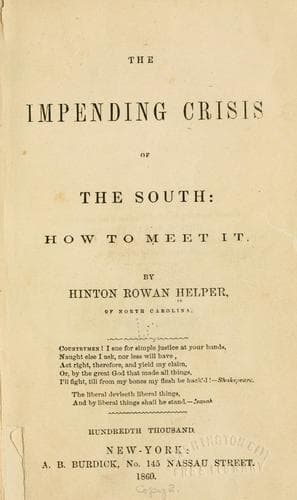
The Impending Crisis of the South: How to Meet ItHelper, Hinton Rowan
History
The Impending Crisis of the South: How to Meet It
Helper, Hinton Rowan
Slavery -- United States
"It may be painful, but nevertheless, profitable, to recur occasionally to
the history of the past; to listen to the admonitions of experience, and
learn lessons of wisdom from the efforts and actions of those who have
preceded us in the drama of human life. The records of former days show
that at a period not very remote, Virginia stood pre-eminently the first
commercial State in the Union; when her commerce exceeded in amount that
of all the New England States combined; when the City of Norfolk owned
more than one hundred trading ships, and her direct foreign trade exceeded
that of the City of New-York, now the centre of trade and the great
emporium of North America. At the period of the war of independence, the
commerce of Virginia was four times larger than that of New-York."
The cash value of all the farms, farming implements and machinery in
Virginia, in 1850, was $223,423,315; the value of the same in New-York, in
the same year, was $576,631,568. In about the same ratio does the value of
the agricultural products and live stock of New-York exceed the value of
the agricultural products and live stock of Virginia. But we will pursue
this humiliating comparison no further. With feelings mingled with
indignation and disgust, we turn from the picture, and will now pay our
respects to
MASSACHUSETTS AND NORTH CAROLINA.
In 1790, Massachusetts contained 378,717 inhabitants; in the same year
North Carolina contained 393,751; in 1850, the population of Massachusetts
was 994,514, all freemen; while that of North Carolina was only 869,039,
of whom 288,548 were slaves. Massachusetts has an area of only 7,800
square miles; the area of North Carolina is 50,704 square miles, which,
though less than Virginia, is considerably larger than the State of
New-York. Massachusetts and North Carolina each have a harbor, Boston and
Beaufort, which harbors, with the States that back them, are, by nature,
possessed of about equal capacities and advantages for commercial and
manufacturing enterprise. Boston has grown to be the second commercial
city in the Union; her ships, freighted with the useful and unique
inventions and manufactures of her ingenious artisans and mechanics, and
bearing upon their stalwart arms the majestic flag of our country, glide
triumphantly through the winds and over the waves of every ocean. She has
done, and is now doing, great honor to herself, her State and the nation,
and her name and fame are spoken with reverence in the remotest regions of
the earth.
Public-domain text, read in full here on John Shaqi.
Reviews
Reviews
No reviews yet
Be the first to share your thoughts on this work.
Join the Discussion
Join the discussion
Sign in to leave a comment or review.
Sign InorCreate an account