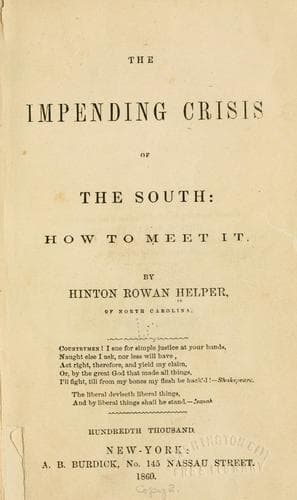
The Impending Crisis of the South: How to Meet ItHelper, Hinton Rowan
History
The Impending Crisis of the South: How to Meet It
Helper, Hinton Rowan
Slavery -- United States
How is it with Beaufort, in North Carolina, whose harbor is said to be the
safest and most commodious anywhere to be found on the Atlantic coast
south of the harbor of New-York, and but little inferior to that? Has
anybody ever heard of her? Do the masts of her ships ever cast a shadow on
foreign waters? Upon what distant or benighted shore have her merchants
and mariners ever hoisted our national ensign, or spread the arts of
civilization and peaceful industry? What changes worthy of note have taken
place in the physical features of her superficies since "the evening and
the morning were the third day?" But we will make no further attempt to
draw a comparison between the populous, wealthy, and renowned city of
Boston and the obscure, despicable little village of Beaufort, which,
notwithstanding "the placid bosom of its deep and well-protected harbor,"
has no place in the annals or records of the country, and has scarcely
ever been heard of fifty miles from home.
In 1853, the exports of Massachusetts amounted to $16,895,304, and her
imports to $41,367,956; during the same time, and indeed during all the
time, from the period of the formation of the government up to the year
1853, inclusive, the exports and imports of North Carolina were so utterly
insignificant that we are ashamed to record them. In 1850, the products of
manufactures, mining and the mechanic arts in Massachusetts, amounted to
$151,137,145; those of North Carolina, to only $9,111,245. In 1856, the
products of these industrial pursuits in Massachusetts had increased to
something over $288,000,000, a sum more than twice the value of the entire
cotton crop of all the Southern States! In 1850, the cash value of all the
farms, farming implements and machinery in Massachusetts, was
$112,285,931; the value of the same in North Carolina, in the same year,
was only $71,823,298. In 1850, the value of all the real and personal
estate in Massachusetts, without recognizing property in man, or setting a
monetary price on the head of a single citizen, white or black, amounted
to $573,342,286; the value of the same in North Carolina, including
negroes, amounted to only $226,800,472. In 1856, the real and personal
estate assessed in the City of Boston amounted in valuation to within a
fraction of $250,000,000, showing conclusively that so far as dollars and
cents are concerned, that single city could buy the whole State of North
Carolina, and by right of purchase, if sanctioned by the Constitution of
the United States, and by State Constitutions, hold her as a province. In
1850, there were in Massachusetts 1,861 native white and free colored
persons over twenty years of age who could not read and write; in the
same year, the same class of persons in North Carolina numbered 80,083;
while her 288,548 slaves were, by legislative enactments, kept in a state
of absolute ignorance and unconditional subordination.
Public-domain text, read in full here on John Shaqi.
Reviews
Reviews
No reviews yet
Be the first to share your thoughts on this work.
Join the Discussion
Join the discussion
Sign in to leave a comment or review.
Sign InorCreate an account