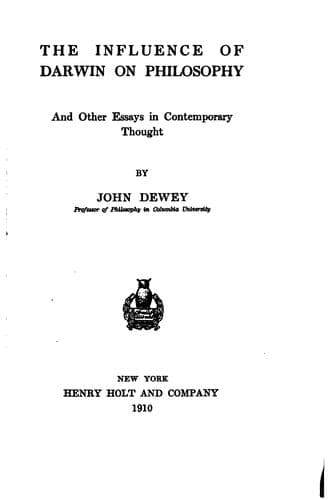
The Influence of Darwin on Philosophy, and other essays in contemporary thoughtDewey, John
Philosophy
The Influence of Darwin on Philosophy, and other essays in contemporary thought
Dewey, John
Evolution; Philosophy; Pragmatism
This bulky and coherent body of testimony is not, of course, of itself
philosophy. But it supplies, at all events, facts that have scientific
backing, and that are as worthy of regard as the facts pertinent to any
science. At the present time these facts seem to have some peculiar
claim just because they present traits largely ignored in prior
philosophic formulations, while those belonging to mathematics and
physics have so largely wrought their sweet will on systems. Again, it
would seem as if in philosophies built deliberately upon the knowledge
principle, any body of known facts should not have to clamor for
sympathetic attention.
Such being the case, the reasons for ruling psychology and sociology
and allied sciences out of competency to give philosophic testimony
have more significance than the bare denial of jurisdiction. They are
evidences of the deep-rooted preconception that whatever concerns a
particular conscious agent, a wanting, struggling, satisfied and
dissatisfied being, must of course be only “phenomenal” in import.
This aversion is the more suggestive when the professed idealist
appears as the special champion of the virginity of pure knowledge.
The idealist, so content with the notion that consciousness determines
reality, provided it be done once for all, at a jump and in lump, is
so uneasy in presence of the idea that empirical conscious beings
genuinely determine existences now and here! One is reminded of the
story told, I think, by Spencer. Some committee had organized and
contended, through a long series of parliaments, for the passage of
a measure. At last one of their meetings was interrupted with news
of success. Consternation was the result. What was to become of the
occupation of the committee? So, one asks, what is to become of
idealism at large, of the wholesale unspecifiable determination of
“reality” by or in “consciousness,” if specific conscious beings, John
Smiths, and Susan Smiths (to say nothing of their animal relations),
beings with bowels and brains, are found to exercise influence upon the
character and existence of reals?
One would be almost justified in construing idealism as a Pickwickian
scheme, so willing is it to idealize the principle of intelligence
at the expense of its specific undertakings, were it not that this
reluctance is the necessary outcome of the Stoic basis and tenor of
idealism--its preoccupation with logical contents and relations in
abstraction from their _situs_ and function in conscious living beings.
IV
Public-domain text, read in full here on John Shaqi.
Reviews
Reviews
No reviews yet
Be the first to share your thoughts on this work.
Elsewhere in the archive
Join the Discussion
Join the discussion
Sign in to leave a comment or review.
Sign InorCreate an account