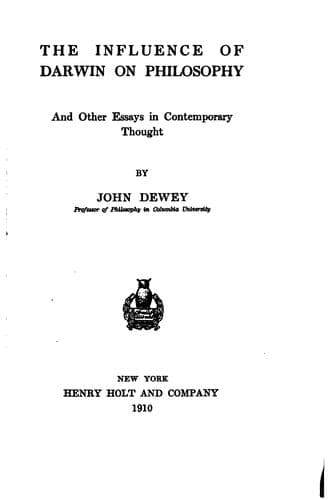
The Influence of Darwin on Philosophy, and other essays in contemporary thoughtDewey, John
Philosophy
The Influence of Darwin on Philosophy, and other essays in contemporary thought
Dewey, John
Evolution; Philosophy; Pragmatism
When Kant compared his work in philosophy to that of the men who
introduced construction into geometry, and experimentation into physics
and chemistry, the point of his remarks depends upon taking the _a
priori_ worth of thought in a regulative, directive, controlling sense,
thought as consciously, intentionally, making an experience _different_
in a _determinate_ sense and manner. But the point of his answer to
Hume consists in taking the _a priori_ in the other sense, as something
which is _already_ immanent in _any_ experience, and which accordingly
makes no determinate difference to any one experience as compared with
any other, or with any past or future form of itself. The concept is
treated first as that which makes an experience actually different,
controlling its evolution towards consistency, coherency, and objective
reliability; then, it is treated as that which has already effected
the organization of any and every experience that comes to recognition
at all. The fallacy from which he never emerges consists in vibrating
between the definition of a concept as a rule of constructive synthesis
in a _differential_ sense, and the definition of it as a static
endowment lurking in “mind,” and giving automatically a hard and fixed
law for the determination of every experienced object. The _a priori_
conceptions of Kant as immanent fall, like the rain, upon the just and
the unjust; upon error, opinion, and hallucination. But Kant slides
into these _a priori_ functions the preferential values exercised
by empirical reflective thought. The concept of triangle, taken
geometrically, means doubtless a determinate method of construing space
elements; but to Kant it also means something that exists in the mind
_prior_ to all such geometrical constructions and that unconsciously
lays down the law not only for their conscious elaboration, but also
for any space perception, even for that which takes a rectangle to
be a triangle. The first of the meanings is intelligible, and marks a
definite contribution to the logic of science. But it is not “objective
idealism”; it is a contribution to a revised empiricism. The second is
a dark saying.
That organization of some sort exists in every experience I make no
doubt. That isolation, discrepancy, the fragmentary, the incompatible,
are brought to recognition and to logical function only with reference
to some prior existential mode of organization seems clear. And
it seems equally clear that reflection goes on with profit only
because the materials with which it deals have already some degree
of organization, or exemplify various relationships. As against
Hume, or even Locke, we may be duly grateful to Kant for enforcing
acknowledgment of these facts. But the acknowledgment means simply an
improved and revised empiricism.
Public-domain text, read in full here on John Shaqi.
Reviews
Reviews
No reviews yet
Be the first to share your thoughts on this work.
Elsewhere in the archive
Join the Discussion
Join the discussion
Sign in to leave a comment or review.
Sign InorCreate an account