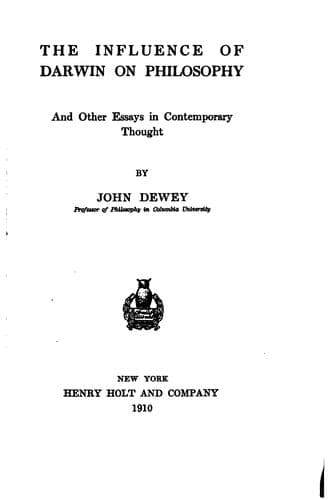
The Influence of Darwin on Philosophy, and other essays in contemporary thoughtDewey, John
Philosophy
The Influence of Darwin on Philosophy, and other essays in contemporary thought
Dewey, John
Evolution; Philosophy; Pragmatism
For, be it noted, this organization, first, is not the work of reason
or thought, unless “reason” be stretched beyond all identification;
and, secondly, it has no sacrosanct or finally valid and worthful
character. (1) Experience always carries with it and within it certain
systematized arrangements, certain classifications (using the term
without intellectualistic prejudice), coexistent and serial. If we
attribute these to “thought” then the structure of the brain of a
Mozart which hears and combines sounds in certain groupings, the
psycho-physical visual habit of the Greek, the locomotor apparatus of
the human body in the laying-out and plotting of space is “thought.”
Social institutions, established political customs, effect and
perpetuate modes of reaction and of perception that compel a certain
grouping of objects, elements, and values. A national constitution
brings about a definite arrangement of the factors of human action
which holds even physical things together in certain determinate
orders. Every successful economic process, with its elaborate divisions
and adjustments of labor, of materials and instruments, is just such
an objective organization. Now it is one thing to say that thought has
played a part in the origin and development of such organizations, and
continues to have a rôle in their judicious employment and application;
it is another to say that these organizations _are_ thought, or
are its exclusive product. Thought that functions in these ways is
distinctively _reflective_ thought, thought as practical, volitional,
deliberately exercised for specific aims--thought as an act, an art of
skilled mediation. As _reflective_ thought, its end is to terminate its
own first and experimental forms, and to secure an organization which,
while it may evoke new reflective thinking, puts an end to the thinking
that secured the organization. _As organizations_, as established,
effectively controlling arrangements of objects in experience, their
mark is that they are not thoughts, but habits, customs of action.[37]
Public-domain text, read in full here on John Shaqi.
The Influence of Darwin on Philosophy, and other essays in contemporary thought — John Shaqi
Reviews
Reviews
No reviews yet
Be the first to share your thoughts on this work.
Elsewhere in the archive
Join the Discussion
Join the discussion
Sign in to leave a comment or review.
Sign InorCreate an account