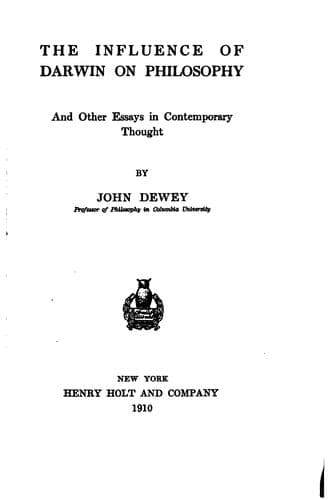
The Influence of Darwin on Philosophy, and other essays in contemporary thoughtDewey, John
Philosophy
The Influence of Darwin on Philosophy, and other essays in contemporary thought
Dewey, John
Evolution; Philosophy; Pragmatism
_That_ an experience will change in content and value is the one thing
certain. _How_ it will change is the one thing naturally uncertain.
Hence the import of the art of reflection and invention. Control of
the character of the change in the direction of the worthful is the
common business of theory and practice. Here is the province of the
episodic recollection of past history and of the idealized foresight
of possibilities. The irrelevancy of an objective idealism lies in the
fact that it totally ignores the position and function of ideality in
sustained and serious endeavor. Were values automatically injected and
kept in the world of experience by any force not reflected in human
memories and projects, it would make no difference whether this force
were a Spencerian environment or an Absolute Reason. Did purpose ride
in a cosmic automobile toward a predestined goal, it would not cease to
be physical and mechanical in quality because labeled Divine Idea, or
Perfect Reason. The moral would be “let us eat, drink, and be merry,”
for to-morrow--or if not this to-morrow, then upon some to-morrow,
unaffected by our empirical memories, reflections, inventions, and
idealizations--the cosmic automobile arrives. Spirituality, ideality,
meaning as purpose, would be the last things to present themselves if
objective idealism were true. Values cannot be both ideal and given,
and their “given” character is emphasized, not transformed, when they
are called eternal and absolute. But natural values become ideal the
moment their maintenance is dependent upon the intentional activities
of an empirical agent. To suppose that values are ideal because
they are so eternally given is the contradiction in which objective
idealism has intrenched itself. Objective ontological teleology
spells machinery. Reflective and volitional, experimental teleology
alone spells ideality.[43] Objective, rationalistic idealism breaks
upon the fact that it can have no intermediary between a brutally
achieved embodiment of meaning (physical in character or else of that
peculiar quasi-physical character which goes generally by the name
of metaphysical) and a total opposition of the given and the ideal,
connoting their mutual indifference and incapacity. An empiricism
that acknowledges the transitive character of experience, and that
acknowledges the possible control of the character of the transition
by means of intelligent effort, has abundant opportunity to celebrate
in productive art, genial morals, and impartial inquiry the grace and
the severity of the ideal.
THE POSTULATE OF IMMEDIATE EMPIRICISM[44]
Public-domain text, read in full here on John Shaqi.
Reviews
Reviews
No reviews yet
Be the first to share your thoughts on this work.
Elsewhere in the archive