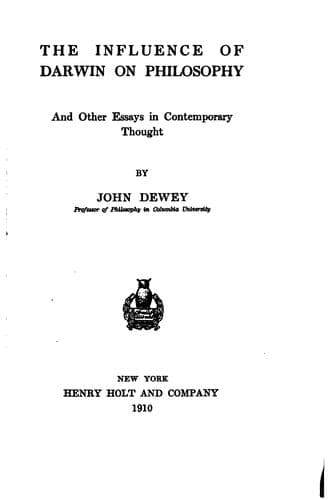
The Influence of Darwin on Philosophy, and other essays in contemporary thoughtDewey, John
Philosophy
The Influence of Darwin on Philosophy, and other essays in contemporary thought
Dewey, John
Evolution; Philosophy; Pragmatism
But, I shall be told, the wall that divides psychology from philosophy
cannot be so easily treated as non-existent. Psychology is a matter of
natural history, even though it may be admitted that it is the natural
history of the course of experience. But philosophy is a matter of
values; of the criticism and justification of certain validities. One
deals, it is said, with genesis, with conditions of temporal origin
and transition; the other with analysis, with eternal constitution. I
shall have to repeat that just this rigid separation of genesis and
analysis seems to me a survival from a pre-evolutionary, a pre-historic
age. It indicates not so much an assured barrier between philosophy
and psychology as the distance dividing philosophy from all science.
For the lesson that mathematicians first learned, that physics and
chemistry pondered over, in which the biological disciplines were
finally tutored, is that sure and delicate analysis is possible only
through the patient study of conditions of origin and development.
The method of analysis in mathematics is the method of construction.
The experimental method is the method of making, of following the
history of production; the term “cause” that has (when taken as an
existent entity) so hung on the heels of science as to impede its
progress, has universal meaning when read as condition of appearance
in a process. And, as already intimated, the conception of evolution
is no more and no less the discovery of a general law of life than it
is the generalization of all scientific method. Everywhere analysis
that cannot proceed by examining the successive stages of its subject,
from its beginning up to its culmination, that cannot control this
examination by discovering the conditions under which successive stages
appear, is only preliminary. It may further the invention of proper
tools of inquiry, it may help define problems, it may serve to suggest
valuable hypotheses. But as science it breathes an air already tainted.
There is no way to sort out the results flowing from the subject-matter
itself from those introduced by the assumptions and presumptions of
our own reflection. Not so with natural history when it is worthy of
its name. Here the analysis is the unfolding of the existence itself.
Its distinctions are not pigeon-holes of our convenience; they are
stakes that mark the parting of the ways in the process itself. Its
classifications are not a grasp at factors resisting further analysis;
they are the patient tracings of the paths pursued. Nothing is more
out of date than to suppose that interest in genesis is interest in
reducing higher forms to cruder ones: it is interest in locating the
exact and objective conditions under which a given fact appears, and
in relation to which accordingly it has its meaning. Nothing is more
naïve than to suppose that in pursuing “natural history” (term of scorn
in which yet resides the dignity of the world-drama) we simply learn
Public-domain text, read in full here on John Shaqi.
Reviews
Reviews
No reviews yet
Be the first to share your thoughts on this work.
Elsewhere in the archive
Join the Discussion
Join the discussion
Sign in to leave a comment or review.
Sign InorCreate an account