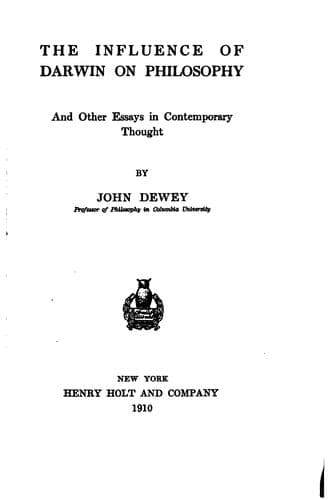
The Influence of Darwin on Philosophy, and other essays in contemporary thoughtDewey, John
Philosophy
The Influence of Darwin on Philosophy, and other essays in contemporary thought
Dewey, John
Evolution; Philosophy; Pragmatism
_Eaton._ Yes; Grimes has about hit off the point of my little
parable--in one of its aspects at least. In matters of daily life you
say a man is “off,” more or less insane, when he deliberately goes
on looking for a certain kind of result from conditions which he has
already found to be such that they cannot possibly yield it. If he
keeps on looking, and then goes about mourning because stage money
won’t buy beefsteaks, or because he cannot keep himself warm by burning
the sea-sands here, you dismiss him as a fool or a hysteric. If you
would condescend to reason with him at all, you would tell him to look
for the conditions that will yield the results; to occupy himself
with some of the countless goods of life for which, by intelligently
directed search, adequate means may be found.
Well, before lunch, Moore was reiterating the old tale. “Modern science
has completely transformed our conceptions of Nature. It has stripped
the universe bare not only of all the moral values which it wore alike
to antique pagan and to our medieval ancestors, but also of any regard,
any preference, for such values. They are mere incidents, transitory
accidents, in her everlasting redistribution of matter in motion; like
the rise and fall of the wave I lament, or like a single musical note
that a screeching, rumbling railway train might happen to emit.” This
is a one-sided view; but suppose it were all so, what is the moral?
Surely, to change our standpoint, our angle of vision; to stop looking
for results among conditions that we know will not yield them; to turn
our gaze to the goods, the values that exist actually and indubitably
in experience; and consider by what natural conditions these particular
values may be strengthened and widened.
Insist, if you please, that Nature as a whole does not stand for good
as a whole. Then, in heaven’s name, just because good is both so plural
(so “numerous”) and so partial, bend your energies of intelligence
and of effort to selecting the specific plural and partial natural
conditions which will at least render values that we do have more
secure and more extensive. Any other course is the way of madness; it
is the way of the spoilt child who cries at the seashore because the
waves do not stand still, and who cries even more frantically in the
mountains because the hills do not melt and flow.
But no. Moore and his school will not have it so: we must “go back of
the returns.” All this science, after all, is a mode of knowledge.
Examine knowledge itself and find it implies a complete all-inclusive
intelligence; and then find (by taking another tack) that intelligence
involves sentiency, feeling, and also will. Hence your very physical
science, if you will only criticise it, examine it, shows that its
object, mechanical nature, is itself an included and superseded element
in an all-embracing spiritual and ideal whole. And there you are.
Public-domain text, read in full here on John Shaqi.
Reviews
Reviews
No reviews yet
Be the first to share your thoughts on this work.
Join the Discussion
Join the discussion
Sign in to leave a comment or review.
Sign InorCreate an account