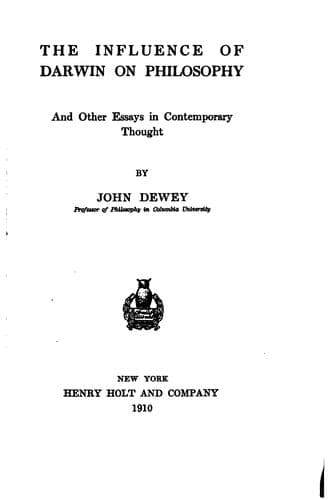
The Influence of Darwin on Philosophy, and other essays in contemporary thought — John Shaqi
The Influence of Darwin on Philosophy, and other essays in contemporary thoughtDewey, John
Philosophy
The Influence of Darwin on Philosophy, and other essays in contemporary thought
Dewey, John
Evolution; Philosophy; Pragmatism
_Grimes._ That’s right, Eaton; give it to them. Of course well-fed and
well-read persons--with their possessions of wealth and of knowledge
both gained at the expense of others--finally get bored; then they
wax sentimental over their boredom and are worried about “Nature” and
its relation to life. Not everybody takes it out that way, of course;
some take motor cars and champagne for that tired feeling. But the
rest--those who aren’t in that class financially, or who consider
themselves too refined for that kind of relief--seek a new sensation in
speculating why that brute old world out there will not stand for what
you call spiritual and ideal values--for short, your egotisms.
The fact is that the whole discussion is only a symptom of the leisure
class disease. If you had to work to the limit and beyond, to keep
soul and body together, and, more than that, to keep alive the soul of
your family in its body, you would know the difference between your
artificial problems and the genuine problem of life. Your philosophic
problems about the relation of “the universe to moral and spiritual
good” exist only in the sentimentalism that generates them. The
genuine question is why social arrangements will not permit the amply
sufficient body of natural resources to sustain all men and women in
security and decent comfort, with a margin for the cultivation of their
human instincts of sociability, love of knowledge and of art.
As I read Plato, philosophy began with some sense of its essentially
political basis and mission--a recognition that its problems were those
of the organization of a just social order. But it soon got lost in
dreams of another world; and even those of you philosophers who pride
yourselves on being so advanced that you no longer believe in “another
world,” are still living and thinking with reference to it. You may
not call it supernatural; but when you talk about a realm of spiritual
or ideal values in general, and ask about its relation to Nature in
general, you have only changed the labels on the bottles, not the
contents in them. For what makes anything transcendental--that is,
in common language, supernatural--is simply and only aloofness from
practical affairs--which affairs in their ultimate analysis are the
business of making a living.
Public-domain text, read in full here on John Shaqi.
Reviews
Reviews
No reviews yet
Be the first to share your thoughts on this work.
Join the Discussion
Join the discussion
Sign in to leave a comment or review.
Sign InorCreate an account